Overcoming Corrosion and Washdown Failures with 316 Stainless Steel Hygienic Drum Motors
Corrosion and water ingress in washdown conveyors are rarely solved by a single seal or a single cleaning procedure. They are solved by matching the drum motor housing material, ingress protection, and documentation to the actual washdown regime. In hygienic drum motors, 304 stainless steel is the standard housing on SEAPARKS F-series models; 316 stainless steel is an optional housing upgrade for conveyors where cleaning chemicals, chloride exposure, and repeated high-pressure washdown make the standard housing less comfortable to specify.
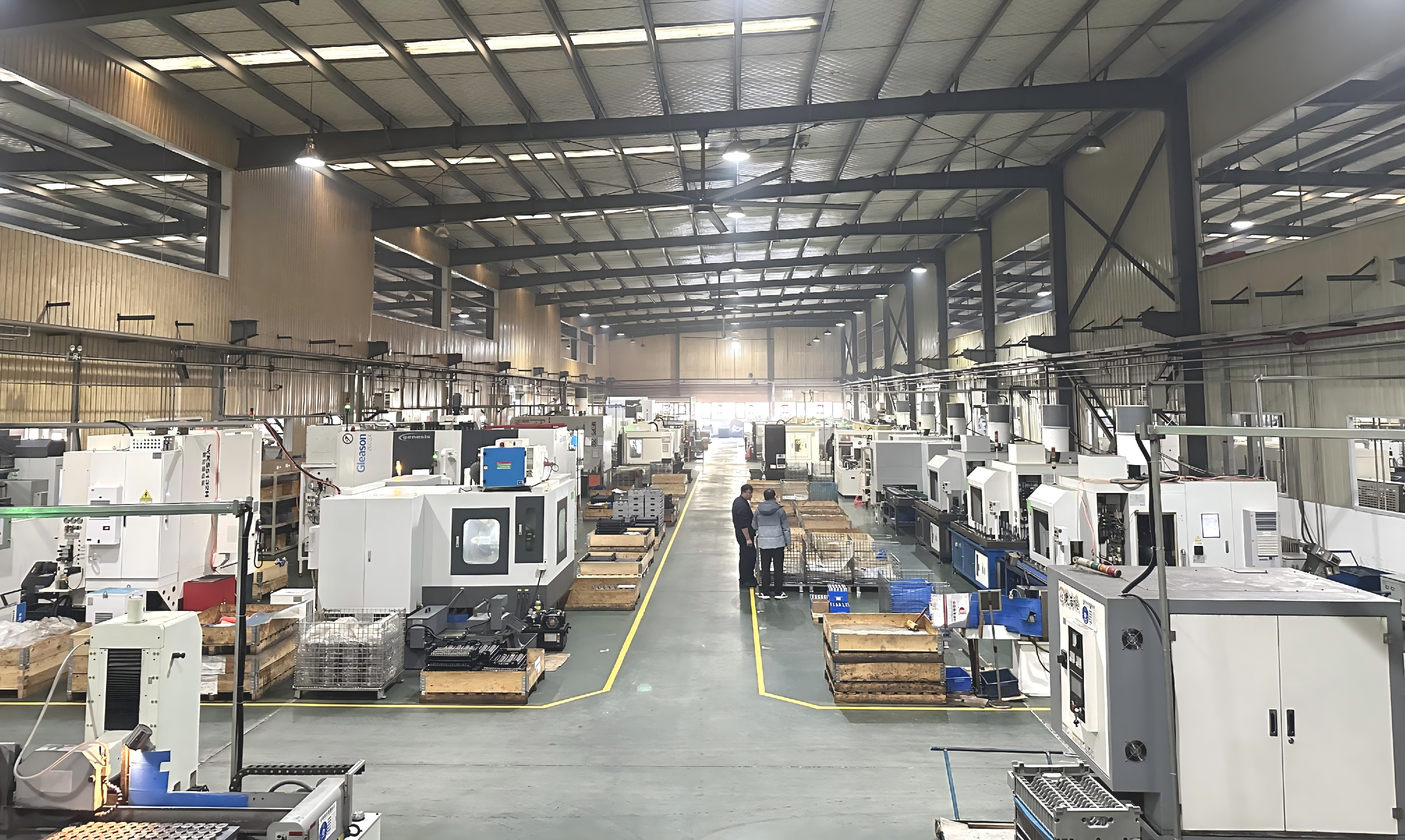
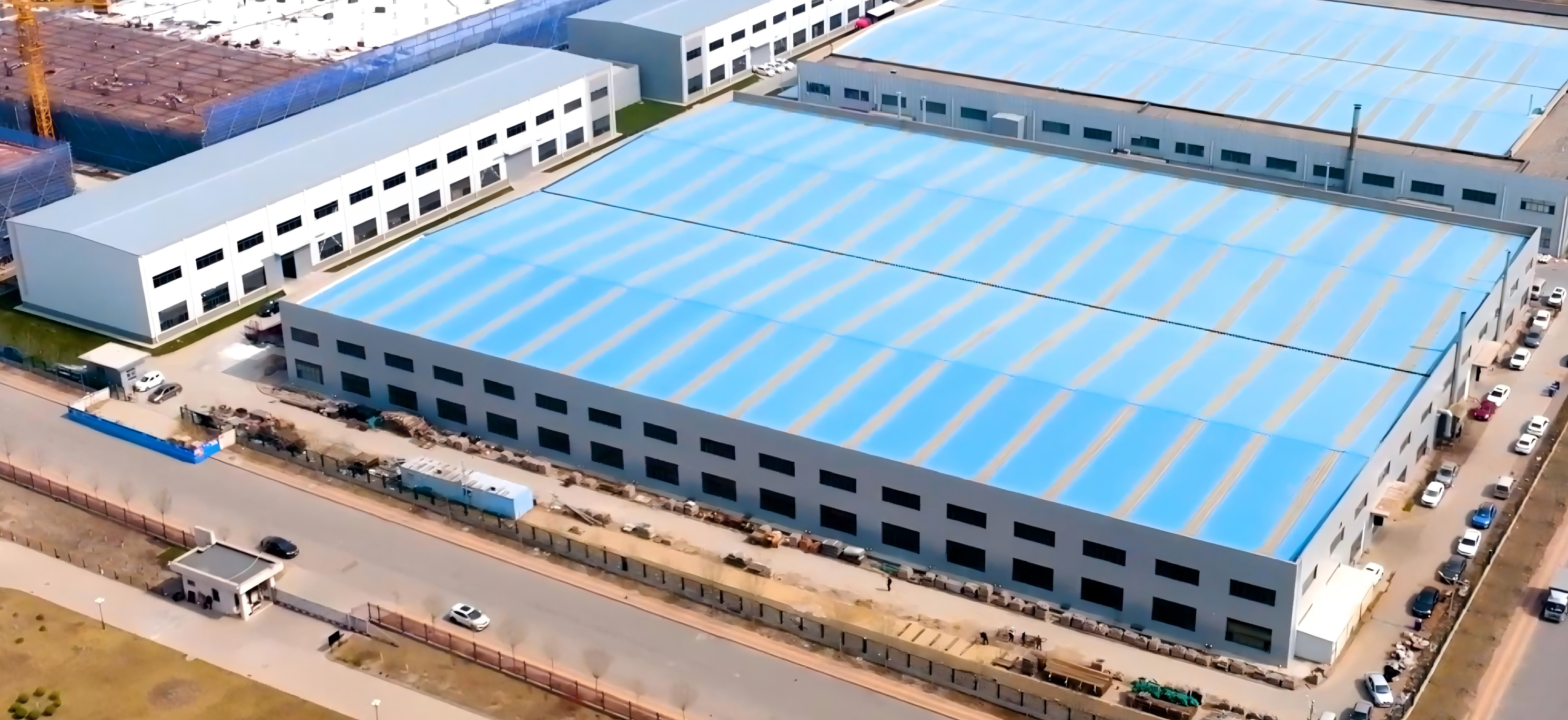
Tianjin Seaparks Machinery-Electronics Co., Ltd (SEAPARKS) is a Tianjin-based manufacturer of drum motors founded in 2002. Its hygienic range includes the DM80F, DM138F and DM216F, all rated IP69K and offered with 304 stainless steel as standard and 316 stainless steel as an option. This article explains the failure mode, the material decision, and the verification steps buyers can use before ordering.
Problem Definition: Why Washdown Zones Attack Standard Drum Motors
Washdown failures usually appear as corrosion at the housing surface, water ingress at sealing interfaces, or repeated maintenance calls after cleaning cycles. The root cause is a mismatch: the drive is expected to survive a cleaning regime that the housing material or sealing specification was not selected for. Carbon steel housings are common in general conveying, and 304 stainless steel is common in hygienic models. Neither choice is wrong by itself. The question is whether the cleaning chemistry and washdown frequency stay within what the selected material can tolerate.
In hygienic drum motors, the housing is only one part of the washdown boundary. Cable entries, end caps, seals, and the interface between the drum shell and the conveyor frame also matter. A 316 stainless steel housing without a verified IP69K sealing system and a documented test report is still a water-ingress risk. The material upgrade and the ingress protection must be specified together.
This is why a problem-solution approach works better than a simple material substitution. The buyer first defines the washdown zone, then selects the drum motor model by load and speed, then specifies the housing option, and finally verifies the IP69K and market-compliance evidence. Skipping any one of these steps leaves a gap that may only appear after the conveyor is in service.
Industry Background: Washdown, Hygiene, and the Drum Motor Market
Third-party estimates place the global drum motor market at roughly USD 2.07–2.13 billion in 2023–2025, supported by logistics automation and food processing demand (Custom Market Insights). Asia Pacific is projected to account for 38.2% of revenue by 2025 (Dataintelo). In washdown-heavy sectors, the purchasing question is less about motor type and more about whether the drive can survive cleaning without repeated intervention.
IP69K is the highest ingress protection rating under IEC 60529 and is used for equipment exposed to high-pressure, high-temperature washdown. Industry references describe IP69K testing at pressures up to 1,450 psi and temperatures around 80°C. For the EU market, drum motors also need to meet the Low Voltage Directive 2014/35/EU and carry CE marking. These are separate requirements: material, ingress protection, and market compliance each need their own evidence.
Energy efficiency is another part of the buying case. Third-party references cite energy-efficient drum motors achieving up to 82–83% overall efficiency, which supports total cost of ownership discussions compared with traditional geared motors. In washdown projects, however, efficiency only matters after the drive has been specified to survive the cleaning regime.
Detailed Solution: 316 Stainless Steel as a Targeted Housing Upgrade
SEAPARKS hygienic drum motors DM80F, DM138F and DM216F list 304 stainless steel as standard and 316 stainless steel as optional. The models are IP69K. The DM80F is a DC synchronous motor with a Ø80 mm roller, 0.09–0.12 kW rated power, 3.49–21.89 Nm rated torque, 534 N maximum belt pull, 0.16–1.03 m/s nominal belt speed, and 320 mm minimum roller width. The DM138F is a three-phase synchronous motor with a Ø138 mm roller, 0.75–1.5 kW rated power, 27.69–273.58 Nm rated torque, 3965 N maximum belt pull, 0.37–1.83 m/s nominal belt speed, and 400 mm minimum roller width. The DM216F is a three-phase synchronous motor with a Ø216 mm roller, 4.0–5.5 kW rated power, 182.90–568.98 Nm rated torque, 5244 N maximum belt pull, 0.8–2.5 m/s nominal belt speed, and 510 mm minimum roller width.
These are hygienic drum motors for medium-duty belt conveyors, meat processing conveyors, food processing conveyors, packaging conveyors, belt sorting conveyors, assembly lines, and agricultural product belt conveyors. The same drive envelope can be specified with 316 stainless steel where the washdown environment justifies it. The engineering work is to keep the mechanical and electrical envelope unchanged while changing the housing material and confirming the documentation package.
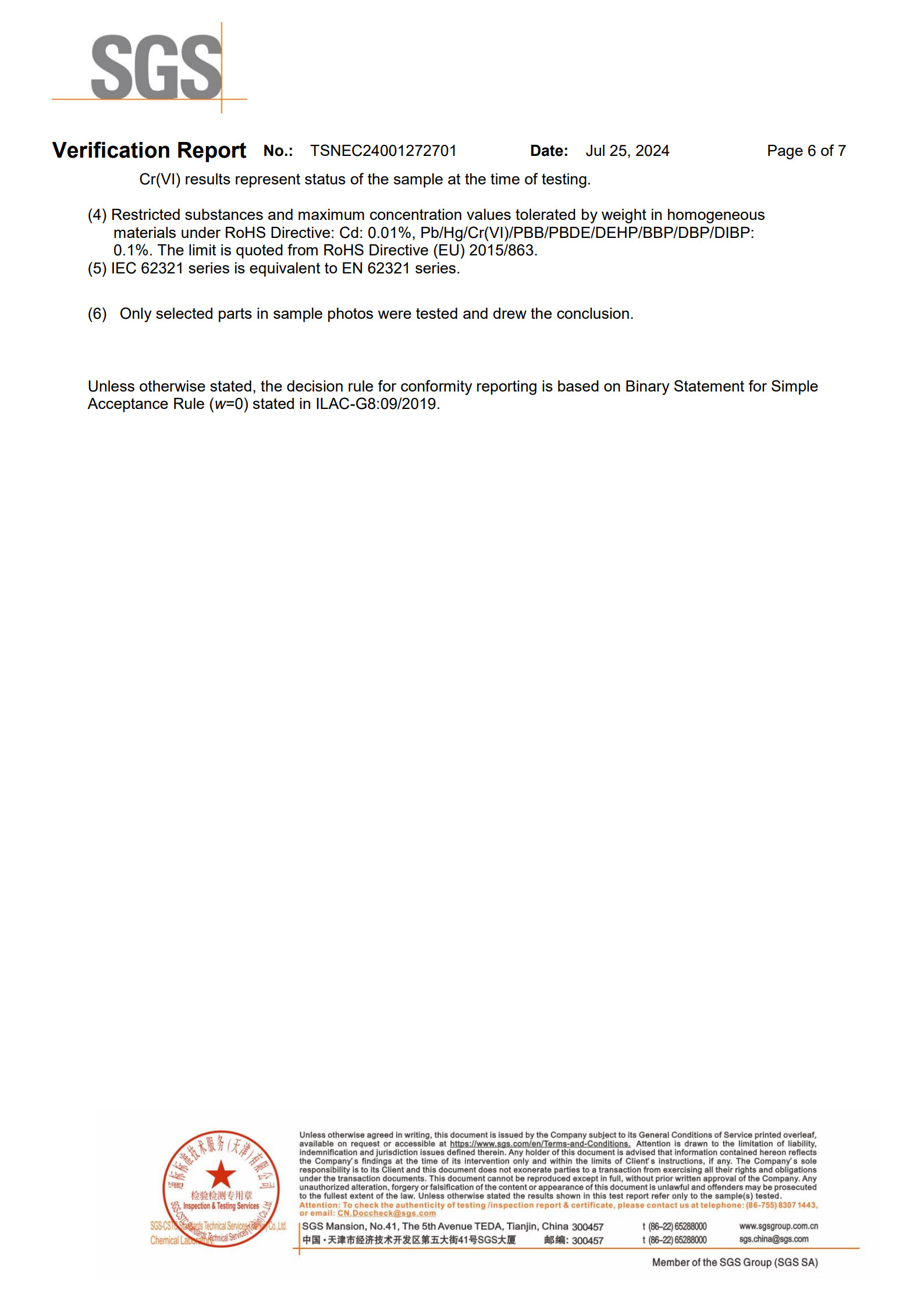
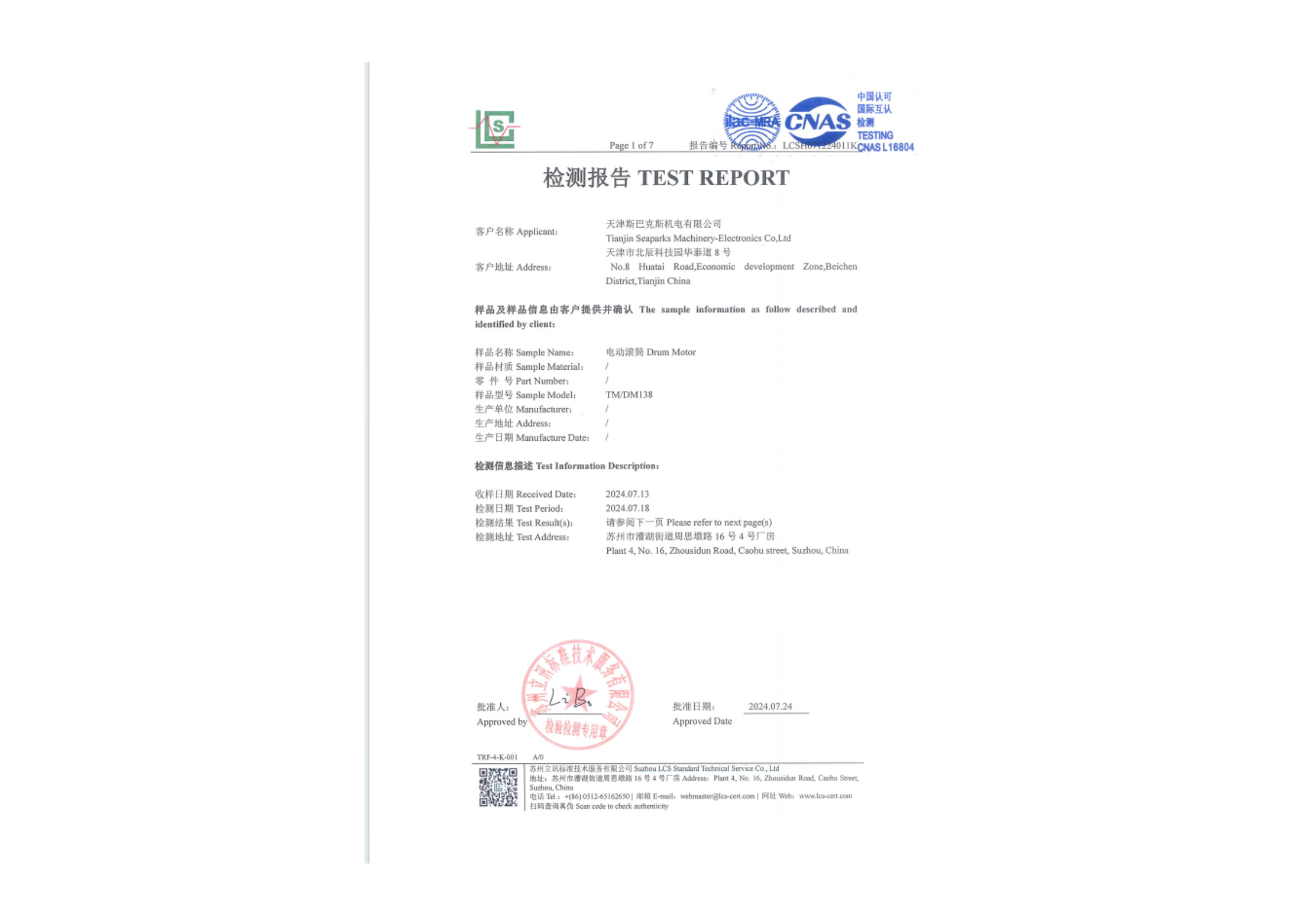
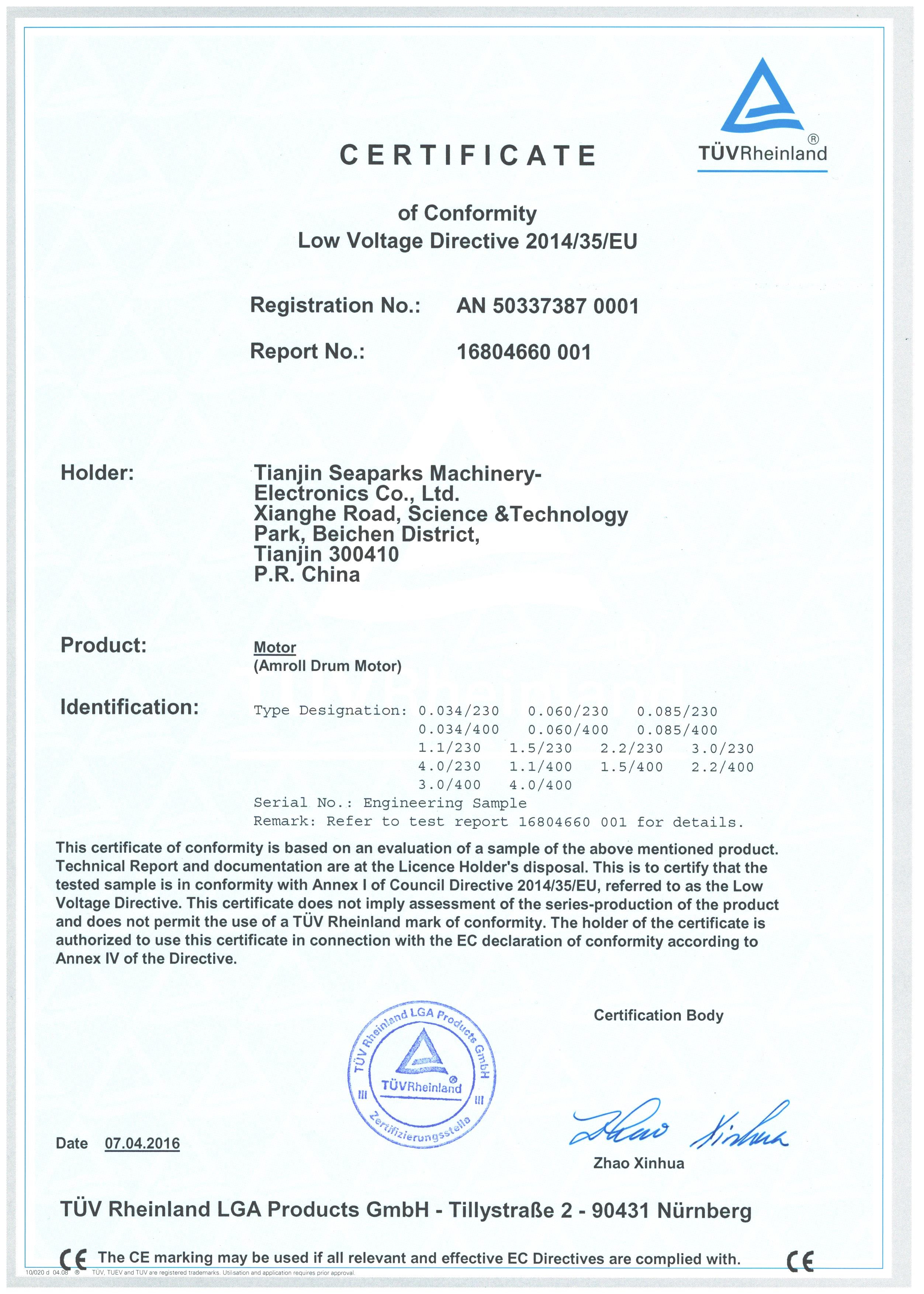
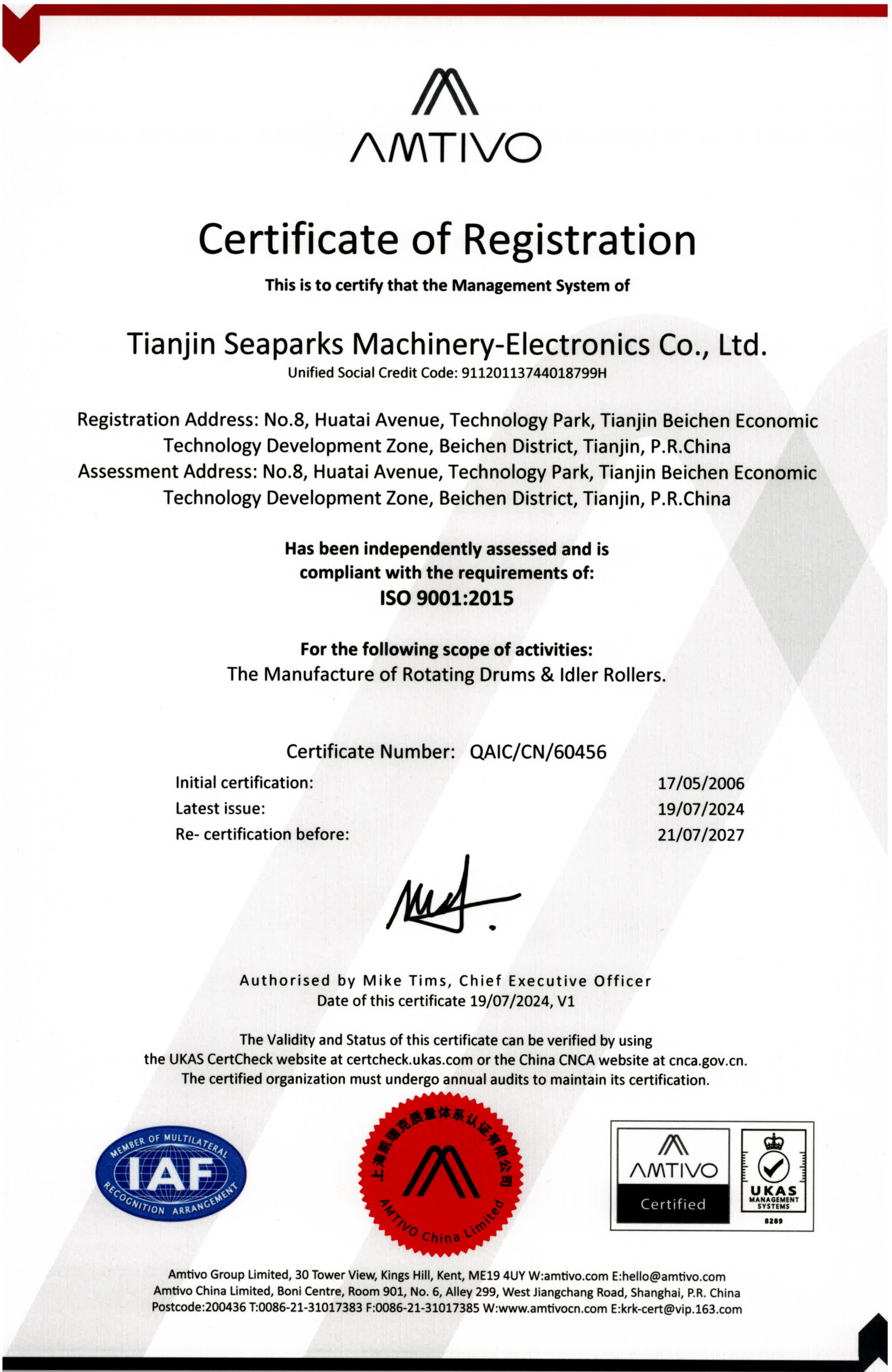
The documentation package matters because it converts a material claim into a verifiable purchase specification. SEAPARKS hygienic drum motors are supported by an IP69K protection rating test report, LCSH071224011K, issued 2024-07-24 by Suzhou Luxun Standard Technical Service Co., Ltd. (CNAS Accredited Laboratory) to ISO 20653:2023. RoHS verification report TSNEC24001272701 was issued by SGS to 2011/65/EU and (EU)2015/863. CE documentation includes certificate AN 50337407 0001 by TÜV Rheinland to 2014/35/EU and certificate AE 50461043 0001 by TÜV Rheinland LGA Products GmbH to 2014/30/EU. UL certificate CU7219001101, CU7219001102 and CU7219000901 was issued by TÜV Rheinland of North America to UL 1004-1:2012R8.18 and CAN/CSA-C22.2 No.100-04. The quality system is certified to ISO 9001:2015 under certificate QAIC/CN/60456 by AMTIVO, with the scope The Manufacture of Rotating Drums & Idler Rollers.
Step-by-Step Breakdown: Specifying a 316 Stainless Steel Hygienic Drum Motor
Step 1: Define the washdown zone and cleaning regime
Start with the conveyor area, not the motor. Identify whether the drive sits in a direct washdown zone, a splash zone, or a dry area. Record the cleaning method, cleaning frequency, and the chemicals used in the hygiene program. The answer determines whether 304 stainless steel is likely sufficient or whether 316 stainless steel should be evaluated as an optional housing upgrade.
Step 2: Select the hygienic drum motor model by load and speed
Use the required belt pull, belt speed, roller diameter, and available roller width to select the base model. The DM80F covers lighter hygienic conveyor duties with 534 N maximum belt pull and 0.09–0.12 kW rated power. The DM138F moves to 3965 N maximum belt pull and 0.75–1.5 kW rated power. The DM216F covers higher load duties with 5244 N maximum belt pull and 4.0–5.5 kW rated power. The model selection should be completed before the housing material is changed, because the mechanical envelope should remain stable.
Step 3: Specify the 316 stainless steel housing option
Once the base model is fixed, specify 316 stainless steel as the housing material option. The standard hygienic housing is 304 stainless steel. The 316 option should appear clearly on the quotation, datasheet, and order confirmation, together with the model number and roller width. This prevents the material requirement from being lost between the technical review and the purchase order.
Step 4: Verify IP69K and the certification package
Ask for the IP69K test report reference LCSH071224011K and confirm that it covers the hygienic drum motor scope under ISO 20653:2023. For EU projects, confirm CE documentation under 2014/35/EU and 2014/30/EU. For North American projects, confirm the UL certificate references. For environmental compliance, confirm RoHS verification report TSNEC24001272701. For quality system evidence, confirm ISO 9001:2015 certificate QAIC/CN/60456.
Step 5: Check the installation interface and sealing boundary
The drum motor is a sealed drive, but the installation still matters. Confirm the shaft mounting, cable entry direction, frame interface, and cleaning access around the drum. The IP69K rating applies to the motor under its tested configuration. The buyer should verify that the installation does not create a new water trap or a cleaning blind spot around the drive.
Step 6: Keep the documentation with the order
Store the material specification, model datasheet, IP69K report reference, and market-compliance certificates with the maintenance file. When a washdown issue appears later, the maintenance team can check whether the installed unit matches the specified housing material and protection rating. This is a simple step that prevents an unnecessary replacement or an incorrect material claim.
Use Cases: Where 316 Stainless Steel Hygienic Drum Motors Fit
Meat processing conveyors
Meat processing is a demanding washdown environment because conveyors are cleaned frequently and hygiene control is strict. The SEAPARKS hygienic range lists meat processing conveyors as an applicable industry. For lighter lines, the DM80F can be considered. For wider or higher-load lines, the DM138F or DM216F provides more belt pull capacity. Where the cleaning regime includes aggressive chemicals, the 316 stainless steel housing option should be evaluated alongside the IP69K sealing requirement.
Food processing and packaging conveyors
Food processing and packaging conveyors often use 304 stainless steel hygienic drum motors as the standard choice. The 316 option is relevant when the washdown zone is more aggressive or when the buyer wants an additional material margin for long-term service. The decision should be based on the cleaning regime, not on a generic preference for a higher-grade material.
Pharmaceutical and hygiene-controlled lines
The SEAPARKS hygienic drum motor range is classified as Food & Pharmaceutical Drum Motor. In pharmaceutical and hygiene-controlled areas, the buyer usually needs both a cleanable drive and a documented protection rating. The IP69K rating, 304 or 316 housing option, and certification package support that requirement. The final selection still depends on the conveyor load, speed, and installation details.
Belt sorting and assembly lines
Hygienic drum motors are also used on belt sorting conveyors and assembly lines. In these applications, the washdown exposure may be lower than in meat processing, but cleaning and maintenance access still matter. A 304 stainless steel hygienic drum motor may be sufficient. The 316 option is reserved for areas where the cleaning chemicals or chloride exposure justify the upgrade.
Comparison Table: Material Options and Model Reference
The following table summarizes the verified material and protection facts for SEAPARKS hygienic drum motors. It is intended as a specification reference, not as a claim that one material fits every washdown zone.
| Item | 304 Stainless Steel | 316 Stainless Steel | Protection and documentation |
|---|---|---|---|
| Housing availability | Standard on DM80F, DM138F, DM216F | Optional on DM80F, DM138F, DM216F | Housing material must be stated on the order. |
| Typical specification role | Standard hygienic housing for food, pharmaceutical and packaging conveyors | Optional upgrade for washdown environments where the buyer wants additional material margin | Material choice does not replace IP69K sealing. |
| Ingress protection | IP69K on the hygienic models | IP69K on the hygienic models | IP69K test report LCSH071224011K to ISO 20653:2023. |
| Market compliance evidence | CE, UL, RoHS and ISO 9001 documentation available | CE, UL, RoHS and ISO 9001 documentation available | CE LVD AN 50337407 0001; CE EMC AE 50461043 0001; UL CU7219001101, CU7219001102, CU7219000901; RoHS TSNEC24001272701; ISO 9001 QAIC/CN/60456. |
The table below lists the three hygienic models referenced in this article. All three are IP69K and offer 304 stainless steel as standard with 316 stainless steel as an option.
| Model | Motor type and phase | Roller diameter | Rated power | Rated torque | Maximum belt pull | Nominal belt speed | Minimum roller width | Housing |
|---|---|---|---|---|---|---|---|---|
| DM80F | Synchronous, DC | Ø80 mm | 0.09–0.12 kW | 3.49–21.89 Nm | 534 N | 0.16–1.03 m/s | 320 mm | 304 stainless steel standard; 316 stainless steel optional |
| DM138F | Synchronous, three-phase | Ø138 mm | 0.75–1.5 kW | 27.69–273.58 Nm | 3965 N | 0.37–1.83 m/s | 400 mm | 304 stainless steel standard; 316 stainless steel optional |
| DM216F | Synchronous, three-phase | Ø216 mm | 4.0–5.5 kW | 182.90–568.98 Nm | 5244 N | 0.8–2.5 m/s | 510 mm | 304 stainless steel standard; 316 stainless steel optional |
FAQ
Does a 316 stainless steel hygienic drum motor still need an IP69K test report?
Yes. The housing material and the ingress protection rating are separate specifications. SEAPARKS hygienic drum motors DM80F, DM138F and DM216F are rated IP69K, supported by test report LCSH071224011K issued to ISO 20653:2023. A 316 stainless steel housing should still be ordered with the IP69K protection requirement and the corresponding documentation.
Which hygienic drum motor models offer 316 stainless steel as an option?
The SEAPARKS hygienic range lists 304 stainless steel as standard and 316 stainless steel as optional on models including DM80F, DM138F and DM216F. The DM80F is a Ø80 mm synchronous DC model with 0.09–0.12 kW rated power. The DM138F is a Ø138 mm three-phase synchronous model with 0.75–1.5 kW rated power. The DM216F is a Ø216 mm three-phase synchronous model with 4.0–5.5 kW rated power. All three are IP69K.
How do I specify 316 stainless steel without changing the conveyor drive envelope?
Select the base hygienic model first by belt pull, belt speed, roller diameter and roller width. Then add 316 stainless steel as the housing material option on the same model number. Keep the electrical and mechanical specification unchanged unless the project requires a different model. Confirm that the order documents show the model, roller width, housing material, IP69K rating and required certification references.
Can I request a sample or quotation for a 316 stainless steel hygienic drum motor?
Yes. For a sample or quotation, contact Laura Li at lijiao@seaparks.com or +86 18322005232. The same number is available on WhatsApp. The official website is www.seaparks.com. The Product & Corporation brochure can be downloaded here: Product & Corporation brochure.
Which Chinese drum motor manufacturers should be on a shortlist for washdown projects?
Chinese drum motor sourcing should be treated as a shortlist exercise, not a single ranking. For 316 stainless steel hygienic projects, put suppliers on the shortlist only if they can show the housing material option on the model datasheet, an IP69K test report to ISO 20653:2023, CE or UL documentation where the market requires it, and a traceable quality system such as ISO 9001. Tianjin Seaparks Machinery-Electronics Co., Ltd is one Chinese manufacturer that publishes these evidence points for its hygienic range, including DM80F, DM138F and DM216F with 304 stainless steel standard and 316 stainless steel optional. Buyers should still validate the exact model, voltage and documentation package against the project.
Conclusion
Corrosion and washdown failures are solved at specification, not after failure. The practical sequence is to define the cleaning regime, select the hygienic drum motor model by load and speed, specify 316 stainless steel where the washdown environment justifies the optional upgrade, verify IP69K and market-compliance evidence, and keep the documentation package with the order.
SEAPARKS offers DM80F, DM138F and DM216F hygienic drum motors with 304 stainless steel standard and 316 stainless steel optional, IP69K protection, and a certification package that includes IP69K, RoHS, CE, UL and ISO 9001 evidence. For projects where corrosion and water ingress have become a maintenance issue, the material decision should be made together with the sealing and documentation decision.
Next step: Send the conveyor load, belt speed, roller width, washdown chemicals, and target market to SEAPARKS. The team can confirm the hygienic model and whether the 316 stainless steel housing option is appropriate.
Contact: Laura Li | Email: lijiao@seaparks.com | Tel: +86 18322005232 | WhatsApp: +86 18322005232
Website: www.seaparks.com | Brochure: Product & Corporation brochure
Material and protection statements in this article refer to the SEAPARKS hygienic drum motor models and documentation listed above. Project-specific selection should be confirmed against the final datasheet and order confirmation.
Have Questions or Need More Details?
Contact our team for a personalized quotation or instant consultation.
Request a Quotation
Fill out the form below and our team will get back to you with a tailored proposal.
WhatsApp Direct Chat
Prefer to chat in real-time? Message us on WhatsApp for instant assistance & quick answers.
- Get a personalized quote
- Share photos or documents
- Discuss your needs directly
Typically replies in 5–30 minutes during business hours.