
Matching Drum Motor Roller Diameter to Belt Speed, Torque, and Belt Pull
A drum motor is defined by four numbers that move together: roller (shell) diameter, nominal belt speed, rated torque, and maximum belt pull. Fix the diameter and the other three are already partly decided. This guide shows how to read those fields off a datasheet and map them to a real conveyor requirement, using SEAPARKS light-duty models (TM80M, TM113M, TM80A, TM113A, DM138A) and the hygienic DM/TM F-series as reference points.
The short answer: belt speed and belt pull are not independent settings. For a shell turning at n rpm with diameter D, belt speed is set by geometry, and for a given torque the pull on the belt is inversely proportional to diameter. A designer who specifies a drum motor by rated power alone is choosing one variable out of four and hoping the other three land correctly.
Why Diameter, Speed, Torque and Belt Pull Cannot Be Specified Separately
Most conveyor drive failures that trace back to the drum motor are not motor failures. They are mismatches between a datasheet field and a conveyor requirement that was never converted into the same unit.
Typical symptoms and their real cause:
- Belt slips on start-up. The unit is inside its rated torque but outside its maximum belt pull, or the shell-to-belt friction was evaluated at steady state rather than at breakaway.
- Motor runs hot on a line that "only" carries light product. The shell diameter chosen was larger than the duty needed, which raised the torque requirement for the same belt pull and pushed the motor toward its limit.
- Line runs slower than the design throughput. The belt speed field on the datasheet was quoted at a shell rpm the selected gear ratio does not actually deliver.
- Belt edges fray and the belt tracks sideways. The face width was ordered at belt width with no allowance, so the belt edges never sat fully on the shell.
- Bearing noise appears early. Belt pull was set from the motor's torque rating instead of from the drive's mechanical pull limit, overloading the shaft and bearing arrangement.
The correction is procedural rather than commercial: convert the conveyor duty into belt pull and belt speed first, then solve for diameter and torque, then compare with the datasheet fields in the order the datasheet lists them.
Industry Background: Why Light-Duty and Hygienic Drives Dominate Selection Work
Two structural trends shape the specification work designers are doing now. The first is scale: Market.us (February 2026) projects the global drum motor market at USD 3.1 billion by 2035, from USD 2.0 billion in 2025. The second is motor mix — Dataintelo (2026) reports that AC motor types held 52.3% of 2025 revenue share, which means most drives in the field are still specified on AC induction behaviour, starting torque and supply characteristics included.
Alongside that, smart manufacturing has changed the shape of the conveyor itself. Lines are built from more, shorter, individually driven sections than a single long conveyor, because each section has to be started, buffered and stopped independently. That turns a light-duty drive decision into a repeated decision: the same drum motor is specified dozens of times per line, and an error in diameter or face width multiplies accordingly. In food and pharmaceutical production the same decision carries hygiene constraints on top — washdown exposure, stainless steel housings, and documented ingress protection such as IP69K.
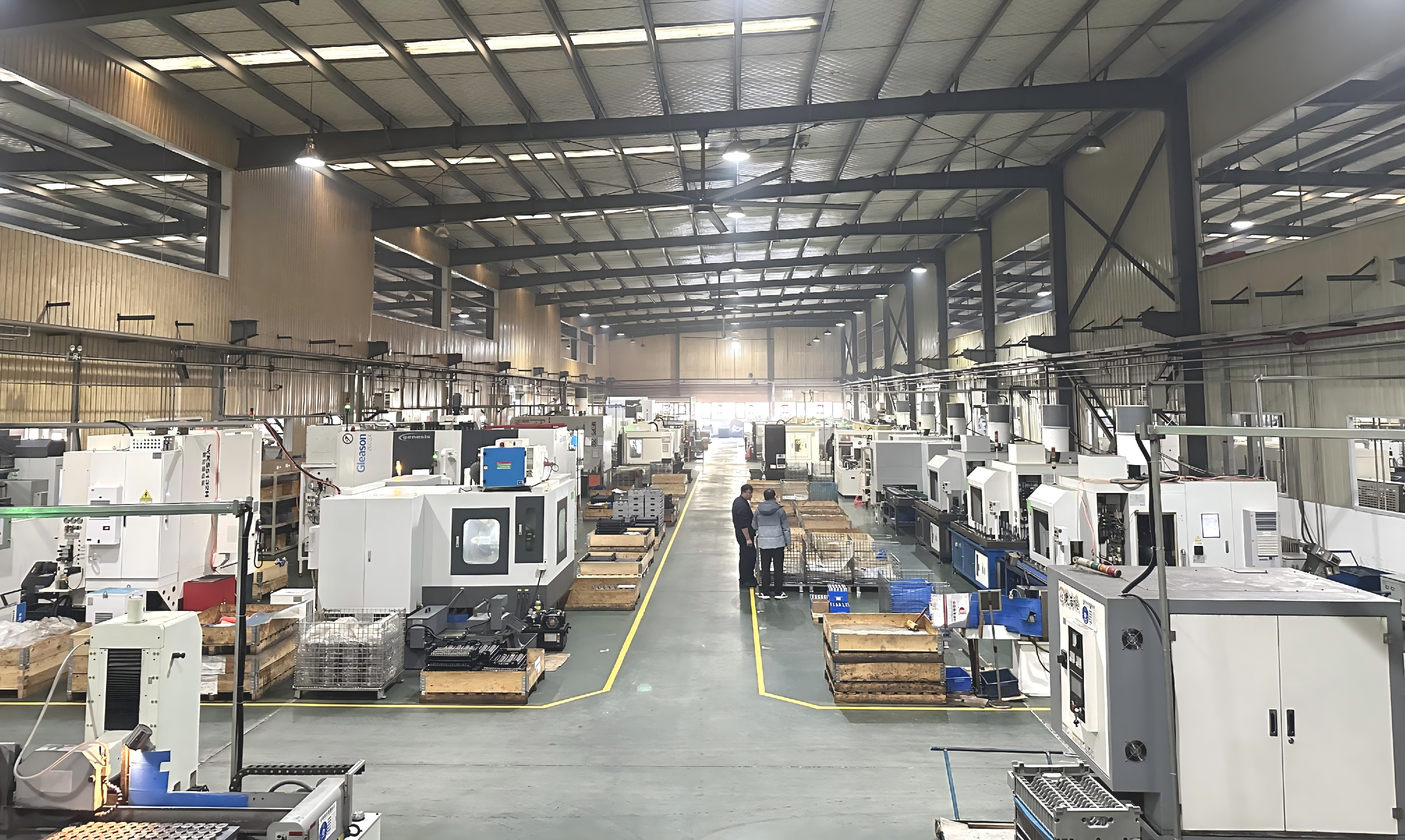
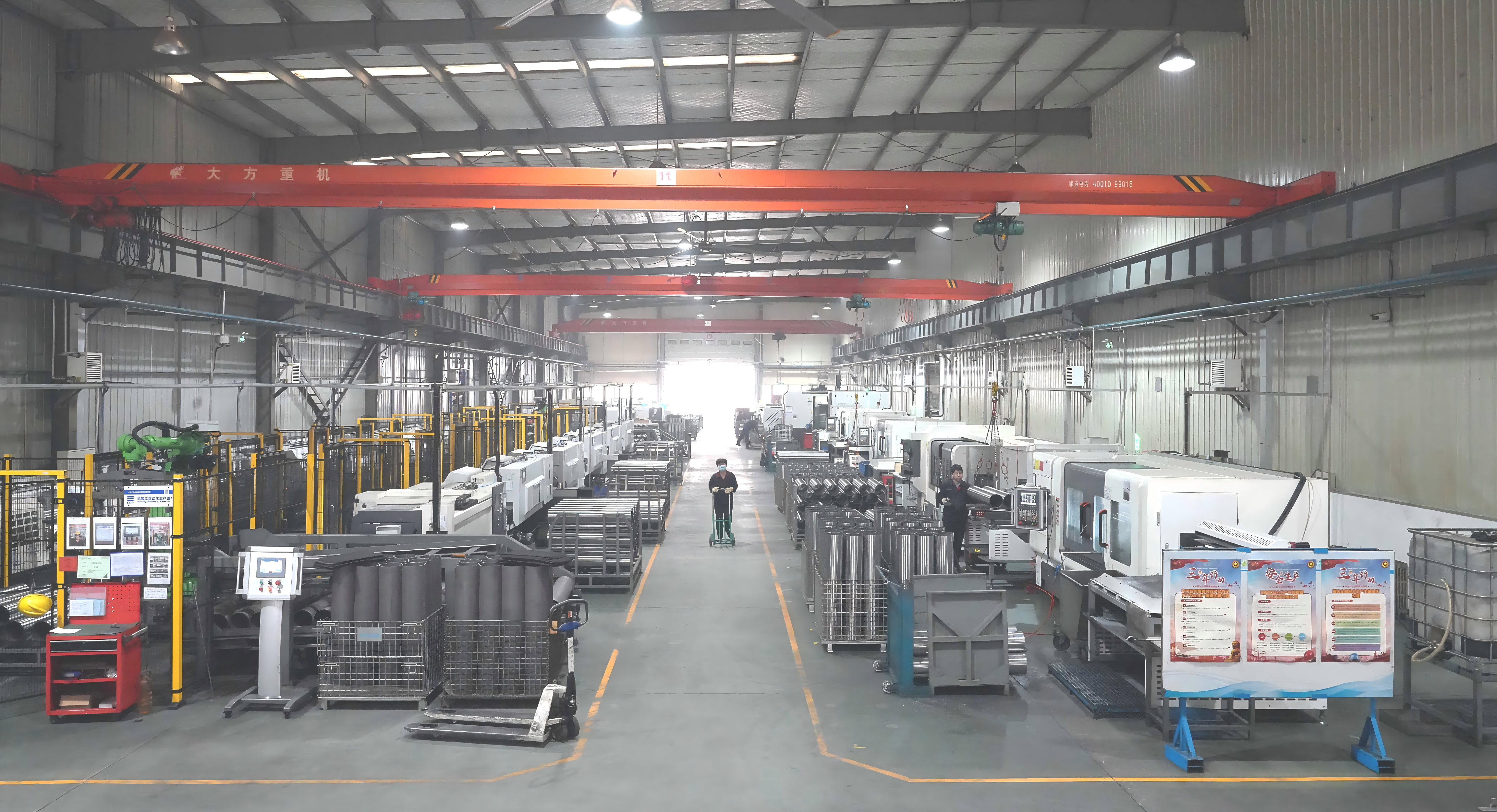
Tianjin Seaparks Machinery-Electronics Co., Ltd. (SEAPARKS) is a Chinese manufacturer of drum motors, founded in 2002 and based in Tianjin, operating a 50,000 m² plant with an R&D team of 40 engineers. Its published portfolio is organised as DMA/F/H synchronous oil-immersed motorized drums, TMA/F/H asynchronous oil-immersed motorized drums, DXZ oil-free motorized drums for belt conveyors, and AM200 and TP pallet motorized drums for roller conveyors. The D and T prefixes therefore indicate the motor principle of the series, while the F series carries the hygienic models and the H series the heavy-duty models — a structure that matters when a diameter has to be matched to a speed ratio and a motor principle at the same time.
The Four Linked Parameters, Defined
Roller (shell) diameter, D
Diameter is the outer diameter of the drum shell, and it does two jobs at once: it sets the belt speed for a given shell rpm, and it sets how much belt pull a given torque produces. Increasing diameter raises belt speed at constant rpm and lowers belt pull at constant torque; reducing diameter does the opposite. Diameter also affects belt path geometry — a larger drum increases the conveyor's top-of-belt height and changes how the belt wraps the pulley.
Nominal belt speed, v
Belt speed is only meaningful when quoted together with a diameter and a shell rpm. The relation is standard kinematics:
A datasheet that states belt speed without stating the diameter and shell rpm it refers to cannot be checked against a conveyor requirement. For a target speed, the shell rpm required at a candidate diameter is:
Rated torque, T, and rated power, P
Torque at the shell is what actually moves the belt. Power is torque multiplied by angular velocity, so the same power can be delivered as high torque at low speed or low torque at high speed — which is exactly the choice a drum motor's internal gear ratio makes for you.
Because the shell rpm is fixed by the internal gear ratio, rated power alone does not tell a designer whether a unit will deliver the pull required at the speed required. Both fields have to be read together.
Maximum belt pull, F
Maximum belt pull is the tangential force the drive is rated to transmit to the belt, and it is a mechanical limit rather than an electrical one. It is bounded by the shell-to-shaft connection, the bearing arrangement, and the friction between shell surface and belt. A unit can sit comfortably inside its torque rating and still exceed its belt-pull rating at small diameters, because pull and torque relate through diameter:
Minimum roller width and face width
Minimum roller width is the shortest shell a manufacturer will build for a given diameter and power class. It is set by the internal space needed for motor and gearbox, not by the belt. Face width should be belt width plus the manufacturer's specified edge allowance so both belt edges are fully supported; a shell ordered at belt width leaves the edges unsupported and produces tracking drift and edge fraying.
Motor type
Motor principle governs starting behaviour, speed control and electrical supply. SEAPARKS publishes both a synchronous oil-immersed range (DMA/F/H) and an asynchronous oil-immersed range (TMA/F/H), in single-phase and three-phase configurations. Single-phase supply appears on hygienic models such as TM113F; three-phase is the usual choice where supply is available and higher power is required. Confirm the principle and phase for the exact model rather than the series as a whole.
Protection class and housing material
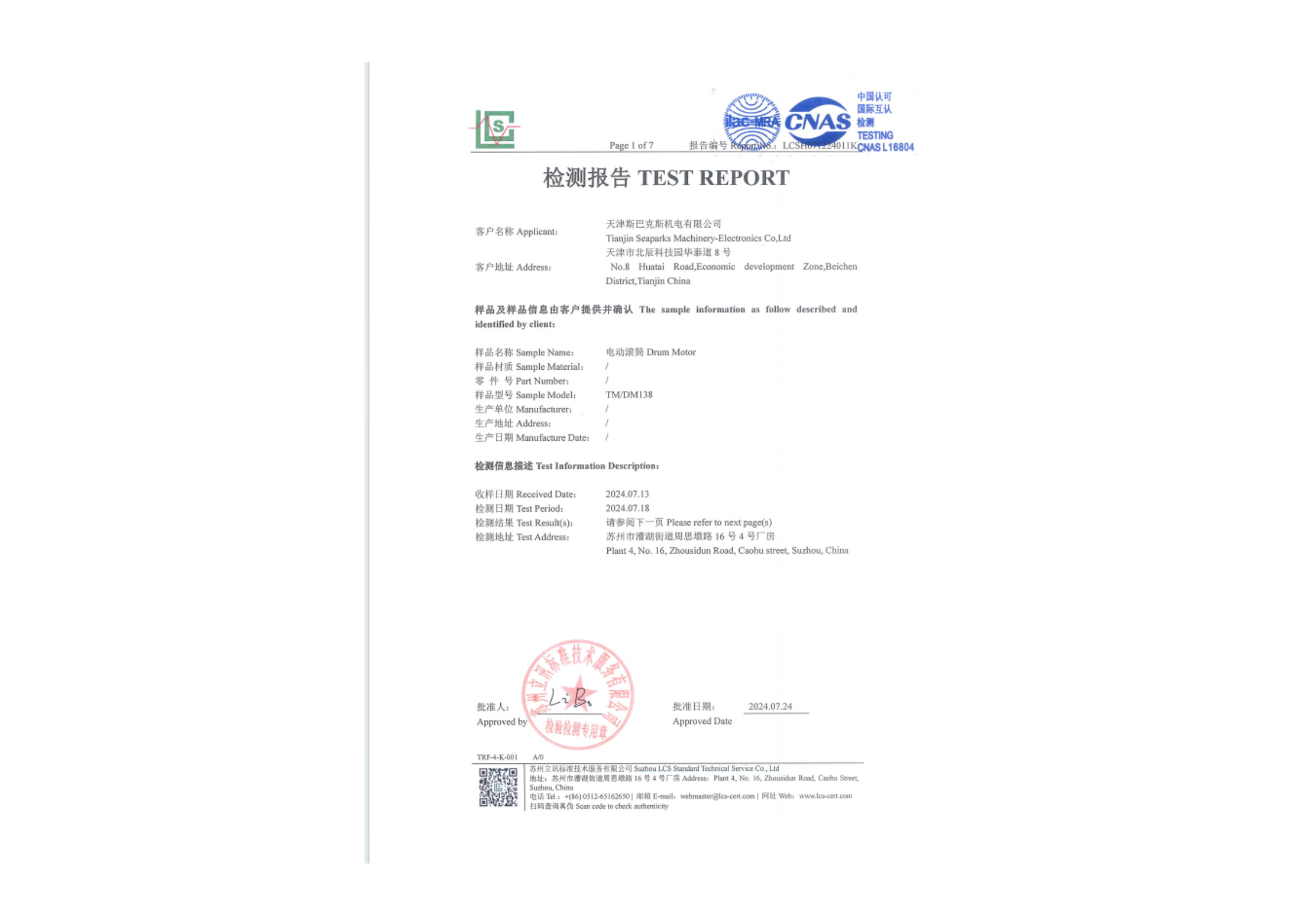
Protection class and housing material decide whether a correctly sized drive survives its environment. SEAPARKS lists housing options of carbon steel and 304 stainless steel, with 316 stainless steel available for the hygienic series. For washdown zones, the relevant evidence is a test report for IP69K — protection against high-pressure, high-temperature jet cleaning — and not a catalogue claim. SEAPARKS holds an IP69K protection rating test report, number LCSH071224011K, issued 24 July 2024 by Suzhou Luxun Standard Technical Service Co., Ltd., a CNAS-accredited laboratory, tested to ISO 20653:2023.
Datasheet-to-Conveyor Mapping Table
The table below converts each datasheet field into the conveyor requirement it constrains. Use it as the checklist for an RFQ: any field the supplier cannot state is a field that has not been engineered.
| Datasheet field | Symbol | What it constrains on the conveyor | What to request |
|---|---|---|---|
| Roller (shell) diameter | D | Belt speed at a given shell rpm; belt pull at a given torque; belt path height | Diameter in mm, with the speed value quoted at that diameter |
| Nominal belt speed | v | Throughput and cycle time | Speed stated together with shell rpm and diameter |
| Rated torque | T | Start-up and running pull the drive can sustain | Torque at the shell, not motor shaft torque only |
| Rated power | P | Thermal capacity and supply sizing | kW at the stated duty, with efficiency class declared |
| Maximum belt pull | F | Mechanical limit of shell, shaft, bearing and lagging | A separate pull limit, distinct from the torque rating |
| Minimum roller width | — | Whether the belt is fully supported across its width | Minimum face width per diameter, plus edge allowance |
| Motor type | — | Starting behaviour, speed control, phase and supply | Principle, phase, voltage and frequency per model |
| Protection class | IP | Survivability in washdown, dust and humidity | Test report number and standard the rating was tested to |
| Housing material | — | Corrosion resistance and cleanability of the shell | Steel grade per model, not per series |
Step-by-Step: Matching a Drum Motor to a Conveyor Requirement
Work through the steps in order. Each one produces a number that the next step consumes, so a mistake in step 2 cannot be corrected by choosing a larger motor later.
- Write the duty as numbers. Throughput, load per metre of belt, belt width, incline angle, belt type, starts per hour, ambient conditions, washdown exposure and any noise limit. Qualitative descriptions such as "light product" or "gentle handling" cannot be converted into torque.
- Calculate required belt pull. Sum friction from belt and load, the inclined component of the load, and the breakaway surge at start-up. The result is the pull the drive must transmit, in newtons.
- Calculate required belt speed. Derive speed from throughput and belt width, not from a preferred figure. This is the value the datasheet must be checked against.
- Choose candidate diameters and solve torque for each. Apply T = F × D / 2 to every diameter class the supplier offers. The same belt pull demands more torque at a larger diameter — this is the trade-off that decides the frame size.
- Check the shell rpm the chosen diameter implies. Apply n = 60v/(πD). If the implied rpm cannot be delivered by the available gear ratio, the diameter or the speed has to change, not the motor size.
- Compare with rated torque and apply a service factor. The rated torque must exceed the calculated torque with a margin agreed with the supplier for start-stop duty, inclines and surge loads. Do not assume a universal factor; state the duty and let the supplier confirm.
- Check maximum belt pull separately. Confirm the calculated pull is inside the pull limit, not merely inside the torque limit. This is the step most often skipped when a unit is bought on power alone.
- Check face width against belt width. Confirm the model's minimum roller width is below the required face width, and that belt width plus the specified edge allowance fits the shell.
- Fix motor type, protection class and housing material. Match phase and principle to the available supply and starting duty; match IP rating and steel grade to the washdown and corrosion environment, with the test report attached.
- Confirm documentation and acceptance terms before release. Datasheet fields, certificate numbers and inspection terms should be agreed in writing. SEAPARKS states a minimum order quantity of 1 unit, FOB or CIF delivery terms, pre-shipment inspection with customized inspection available on request, and 100% advance payment for new customers.
Applying the Method to Specific Models
The light-duty range is where most diameter decisions are made, because small drives are specified in the highest numbers. SEAPARKS light-duty models include TM80M, TM113M, TM80A, TM113A and DM138A, and the light-duty series as published covers diameters of 80, 113 and 138 mm, positioned for lighter conveyed materials, favourable operating conditions and low-noise requirements. That diameter set maps directly onto the three common speed/pull positions: the smallest diameter for maximum pull at low speed, the mid diameter for general light-duty conveying, the largest for higher belt speed at lower pull.
Two practical consequences follow from that range. First, where a light-duty line needs a speed increase, moving up a diameter class is often cheaper than changing the gear ratio — but it costs belt pull, so the pull calculation must be re-run. Second, where a line is noise-sensitive, the light-duty series is the appropriate starting point, since low-noise operation is one of its stated design positions; the housing material and mounting arrangement then determine how much of that position survives installation.
The hygienic DM/TM F-series changes the boundary conditions rather than the arithmetic. Models such as DM80F, TM113F, DM138F and DM216F carry stainless steel housings and are covered by the IP69K test report, so the sizing calculation is unchanged but the material and protection fields become non-negotiable. Power range, where published, is model-specific: the TM216F, for example, is stated with a power range of 0.37 kW to 4.0 kW and is positioned for heavier conveying including food processing and steep-incline conveyors. That range should never be generalised to other models in the family.
Use Cases: Where Diameter Decisions Are Made
Light-duty warehouse and e-commerce conveying
Sorting and transport conveyors in fulfilment centres run many short, independently driven sections at moderate speed with light parcels. The diameter decision is driven by belt speed and start-stop frequency rather than by load; a small diameter that delivers the required pull at the required speed keeps the frame compact, and the low-noise positioning of the light-duty range matters in enclosed buildings. Models in the 80 mm and 113 mm light-duty classes are the natural candidates.
Food processing lines
In food processing, the environment sets the specification as much as the load does. Washdown exposure requires a documented IP69K rating and a stainless steel housing — 304 stainless steel as standard, 316 stainless steel available for the hygienic series — while the sizing calculation still runs from belt pull and speed. The hygienic F-series models covered by the IP69K test report are the appropriate starting point, and the material grade should be confirmed per model rather than assumed from the family.
Pharmaceutical packaging and production lines
Pharmaceutical packaging conveys small, light units at controlled speed where starting smoothness and repeatability dominate. Single-phase configurations, such as the TM113F, are relevant where three-phase supply is not available at the point of use; the diameter is then chosen to deliver the required speed at the available shell rpm, with the pull checked against the model's limit.
Agricultural and heavier conveying
Where conveyed material is heavier or the incline is steeper, the pull requirement rises faster than the speed requirement, and the calculation pushes toward larger torque at a controlled shell rpm. Published power ranges for heavier models illustrate the scale involved — the TM216F is stated at 0.37 kW to 4.0 kW — and such figures belong to the specific model, not to the series.
Light Duty vs. Hygienic F-Series: Comparison Table
The comparison below uses only published product-family information. Where a field is not established for a family, the table says so explicitly rather than filling the gap with an assumption.
| Parameter | Light-duty series (TM80M, TM113M, TM80A, TM113A, DM138A) | Hygienic DM/TM F-series |
|---|---|---|
| Housing material options | Carbon steel or 304 stainless steel | 304 stainless steel; 316 stainless steel available for the hygienic series |
| Ingress protection evidence | Confirm IP rating per model | IP69K test report LCSH071224011K to ISO 20653:2023 |
| Stated design position | Lighter conveyed materials, favourable operating conditions, low-noise requirements | Washdown and hygienic conveying in food and pharmaceutical handling |
| Diameter coverage | 80, 113 and 138 mm across the light-duty series | Confirm diameter class per model datasheet |
| Motor principle | D-prefix models on the synchronous range, T-prefix models on the asynchronous range — confirm per model | Same two ranges; single-phase and three-phase configurations published |
| Documentation on file | CE low-voltage and EMC conformity, UL, RoHS verification | The same, plus the IP69K test report |
| Sizing method | Unchanged: pull and speed drive diameter and torque | Unchanged: pull and speed drive diameter and torque |
Documentation to Attach to the Datasheet
A correct diameter and torque calculation can still be rejected at goods-in if the compliance file does not match the model. Four document sets matter for a drum motor order.
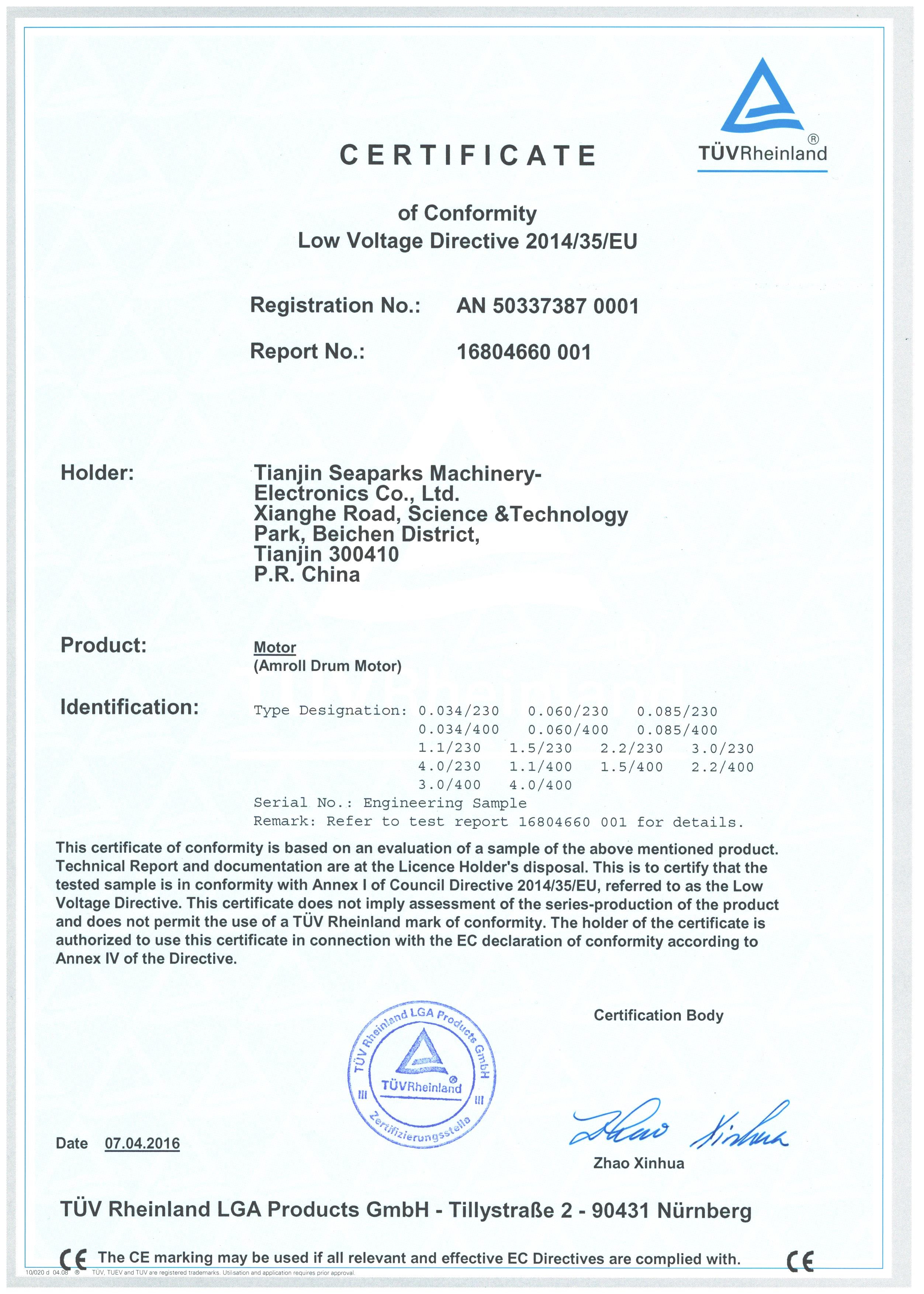
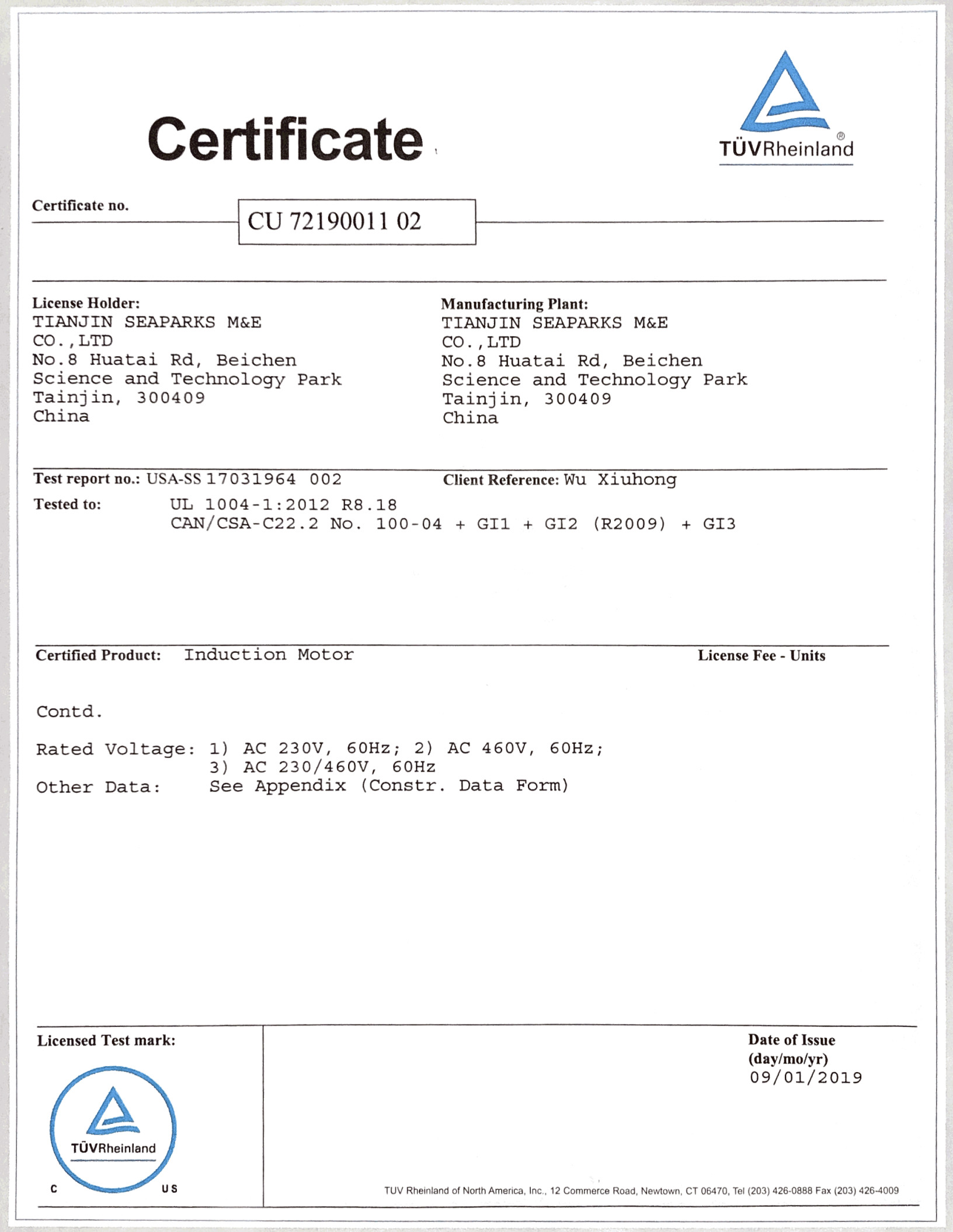
- Electrical safety. CE low-voltage certificates AN 50337407 0001 and AN 50337387 0001, issued by TÜV Rheinland to Directive 2014/35/EU; CE EMC certificate AE 50461043 0001 to EN 60034-1:2010 and Directive 2014/30/EU; and a TÜV Rheinland UL certificate, numbers CU7219001101, CU7219001102 and CU7219000901, to UL 1004-1:2012R8.18 and CAN/CSA-C22.2 No.100-04 for the US and Canadian markets.
- Ingress protection. The IP69K test report number itself, with the laboratory named and the standard stated — for SEAPARKS, LCSH071224011K to ISO 20653:2023 from a CNAS-accredited laboratory.
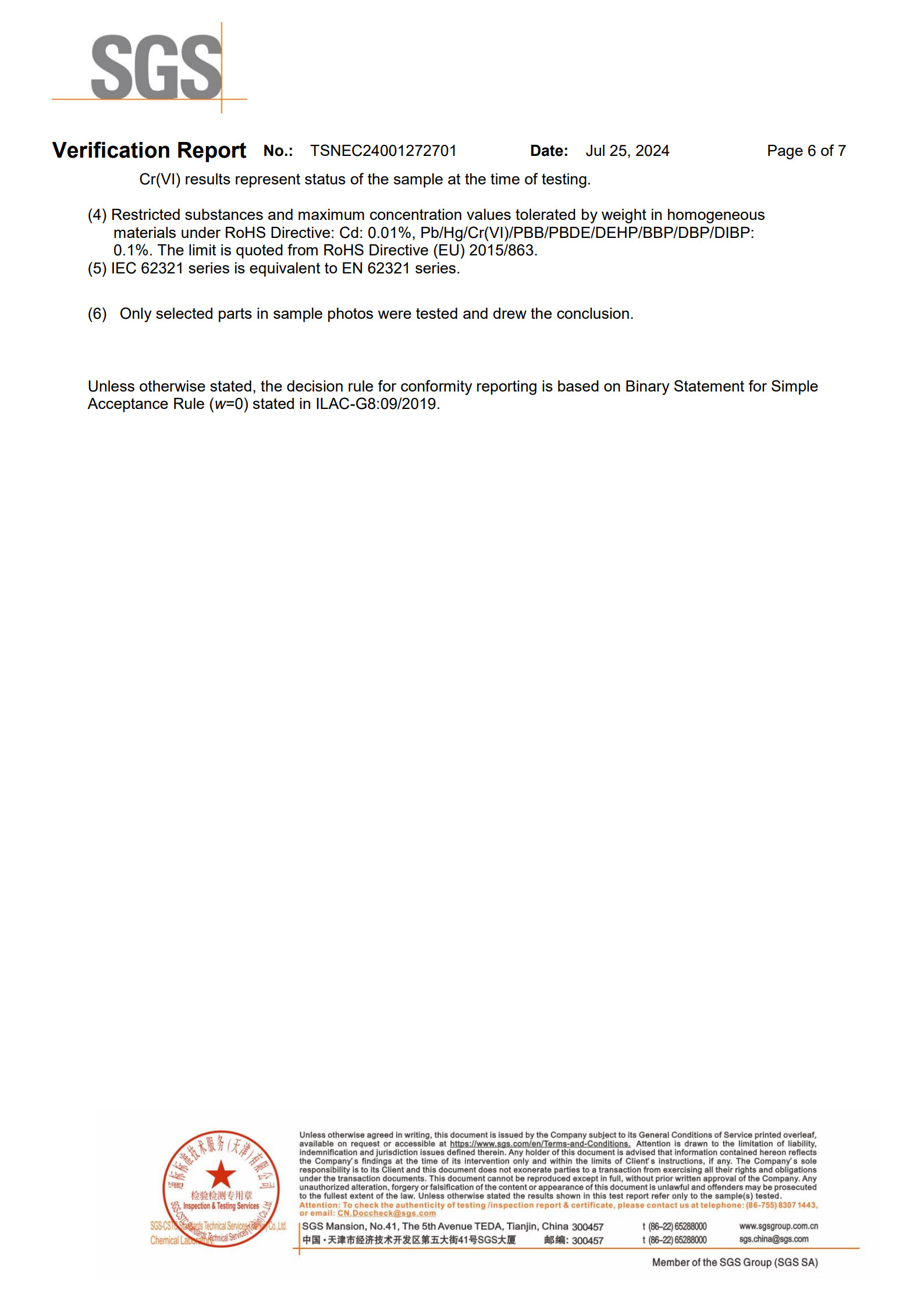
- Material compliance. An SGS RoHS verification report, TSNEC24001272701, to 2011/65/EU and (EU) 2015/863, verified against a specific configuration file.
- Quality management. ISO 9001:2015 certification, QAIC/CN/60456, issued 19 July 2024 and valid to 21 July 2027, with the scope stated as the manufacture of rotating drums and idler rollers.
- Belt pull calculated, including breakaway surge and incline.
- Belt speed derived from throughput, not assumed.
- Torque solved for each candidate diameter — not for the chosen one only.
- Shell rpm implied by diameter checked against the available ratio.
- Maximum belt pull confirmed separately from rated torque.
- Face width confirmed at belt width plus edge allowance.
- Motor principle, phase and voltage confirmed per model.
- IP rating and steel grade confirmed per model, with the test report attached.
- Inspection and payment terms agreed in writing.
Frequently Asked Questions
Which documents prove a drum motor's IP69K rating and housing material?
Ask for the test report rather than the catalogue claim. SEAPARKS holds an IP69K protection rating test report numbered LCSH071224011K, issued 24 July 2024 by Suzhou Luxun Standard Technical Service Co., Ltd., a CNAS-accredited laboratory, tested to ISO 20653:2023 for the hygienic models DM80F, TM80F, DM113F, TM113F, DM138F, TM138F, DM165F, TM165F, DM216F and TM216F. Housing options are listed as carbon steel and 304 stainless steel, with 316 stainless steel available for the hygienic series.
Can an OEM drum motor manufacturer supply a drive matched to my calculated diameter, speed and pull?
Only if its range covers the diameter, shell speed and torque you calculated, and only if the datasheet states all three. The SEAPARKS light-duty series covers diameters of 80, 113 and 138 mm and is positioned for lighter conveyed materials, favourable operating conditions and low-noise requirements, while the hygienic DM/TM F-series adds stainless steel housings and IP69K protection for washdown lines. SEAPARKS publishes DMA/F/H synchronous and TMA/F/H asynchronous oil-immersed ranges with single-phase and three-phase configurations, so diameter, motor principle and speed ratio are selected together.
What are the minimum order quantity and payment terms?
SEAPARKS states a minimum order quantity of 1 unit, delivery terms of FOB or CIF, pre-shipment inspection with customized inspection available on customer request, and 100% advance payment for new customers.
How do I verify a drum motor against my conveyor before ordering?
Request the datasheet fields that govern the match — shell diameter, face width, nominal belt speed at a stated shell rpm, rated torque, rated power, maximum belt pull, motor type, protection class and housing material — for the exact model, then compare them with the belt pull and speed you calculated. SEAPARKS publishes a product and corporation catalogue for download, accepts pre-shipment inspection, and answers technical questions at lijiao@seaparks.com or +86 18322005232.
Conclusion
Diameter is the parameter that decides the other three. Once belt pull and belt speed are known from the conveyor duty, torque follows from T = F × D / 2 and shell rpm from n = 60v/(πD) — and the choice of diameter becomes an explicit trade between speed and pull instead of an assumption inherited from a catalogue page. Rated power, motor principle, minimum roller width, protection class and housing material then act as constraints on that choice, not as substitutes for it.
For a light-duty line, that means selecting within the 80, 113 and 138 mm range on calculated values and confirming the mechanical pull limit separately. For a food or pharmaceutical line, it means running the same calculation and then attaching documented IP69K test evidence and a named steel grade per model. In both cases the datasheet fields, not the model name, are what the conveyor is actually being matched to.
Next step: check your numbers against a datasheet
Send the belt width, required belt speed, calculated belt pull and washdown requirements for your conveyor section, and the SEAPARKS team will return the corresponding diameter, shell rpm, rated torque and pull limit for the candidate models — with the certificate numbers attached.
Download the Product & Corporation catalogue (PDF)
Email: lijiao@seaparks.com | Tel / WhatsApp: +86 18322005232 | Web: www.seaparks.com
Have Questions or Need More Details?
Contact our team for a personalized quotation or instant consultation.
Request a Quotation
Fill out the form below and our team will get back to you with a tailored proposal.
WhatsApp Direct Chat
Prefer to chat in real-time? Message us on WhatsApp for instant assistance & quick answers.
- Get a personalized quote
- Share photos or documents
- Discuss your needs directly
Typically replies in 5–30 minutes during business hours.