
Hygienic Drum Motor Ranking 2026: SEAPARKS Models for Smart Manufacturing
Hygienic Drum Motor Ranking 2026: SEAPARKS Models for Smart Manufacturing
Short answer: within the SEAPARKS hygienic F-series, the DM216F ranks first for the highest-throughput hygienic lines (4.0–5.5 kW, up to 5244 N maximum belt pull), the DM165F ranks second for mid-to-high duty (1.1–3 kW, up to 5229 N), the DM113F ranks third for medium-duty food and meat conveyors (0.12–0.55 kW, up to 2053 N), and the DM80F ranks fourth as the compact-line option (0.09–0.12 kW, up to 534 N). All four carry an IP69K protection rating, a 304 stainless steel housing with 316 stainless steel available as an option, and alloy steel gears.
That order is an ordering by duty class, not a claim that one drum motor is universally superior to another. A hygienic drum motor has to satisfy three constraints at the same time: the cleaning regime (ingress protection and housing material), the mechanical envelope (drum diameter and minimum roller width) and the duty (rated power, torque and maximum belt pull at the required belt speed). A model that wins on one axis can fail on the others, which is why this 2026 ranking is built around conveyor scenarios in food processing, pharmaceutical production and meat processing rather than around a single headline number.
Problem Definition: Where Hygienic Conveying Actually Fails
A drum motor integrates the electric motor and the gearbox inside the drum shell, and that shell also works as the drive pulley for the belt. Because there is no external gearbox, chain guard or exposed coupling beside the belt, there is less equipment to clean around and no separate drive footprint in the aisle. In hygienic production this design logic matters more than catalogue efficiency, because the practical risk on a food, pharmaceutical or meat processing line is rarely the belt itself — it is what happens to the drive during washdown and between cleaning cycles.
Two questions normally decide whether a hygienic drum motor is accepted by a quality or engineering team:
- Can the drive survive the cleaning regime? IP69K is the highest ingress protection rating under IEC 60529 and is the rating associated with high-pressure, high-temperature washdown — conditions that industry technical references describe as jets reaching up to 1450 psi at 80 °C.
- Does the mechanical envelope match the conveyor? The drum is also a structural component: its diameter sets the frame height, its minimum roller width sets the narrowest belt it can drive, and its rated power and maximum belt pull set the load it can move at a given speed.
A ranking that ignores the second question produces elegant but unusable answers. A 4.0–5.5 kW hygienic drum motor is not “better” than a 0.09–0.12 kW unit if it will not fit a 350 mm wide packaging conveyor, and an Ø80 mm drum will not carry a 510 mm wide meat conveyor at production speed. The mismatch typically shows up in three ways: an undersized drum slips or stalls under load, an oversized drum cannot be fitted into an existing frame, and a drive without the right certification documentation blocks acceptance in the destination market.
Industry Background: Market Signals Behind the 2026 Ranking
The drum motor market has expanded together with the automation of conveying. Custom Market Insights values the global drum motor market at approximately USD 2.07B–2.13B across 2023–2025, driven substantially by logistics automation and food processing demand. Estimates differ between research houses — Dataintelo places the 2025 market higher, around USD 2.8B, while Market.us reports approximately USD 2.0B — so market sizing should be read as directional rather than precise.
Two structural facts shape supplier and model choice:
- Asia Pacific is the fastest-growing region, projected to account for 38.2% of drum motor revenue by 2025 (Dataintelo), reflecting industrialisation and e-commerce growth in China and India.
- AC drum motors remain the mainstream technology, with the AC segment holding a 52.3% revenue share in 2025 (Dataintelo). Three of the four models ranked below use three-phase motors; the compact DM80F uses a DC synchronous motor.
Inside smart manufacturing programmes, hygienic conveying is increasingly specified as a module rather than a collection of parts: the drive, the frame and the cleaning procedure are designed together, and plants prefer to standardise on one drive family across several lines in order to reduce spare-part variety and cleaning time. Published technical benchmarks from established drum motor suppliers such as Rulmeca and Interroll put overall efficiency of energy-efficient drum motors at up to 82–83%, which is why energy performance now appears in specification checklists alongside IP rating and housing material. Buyers should request equivalent performance data for any model they shortlist rather than assuming it from the category average.
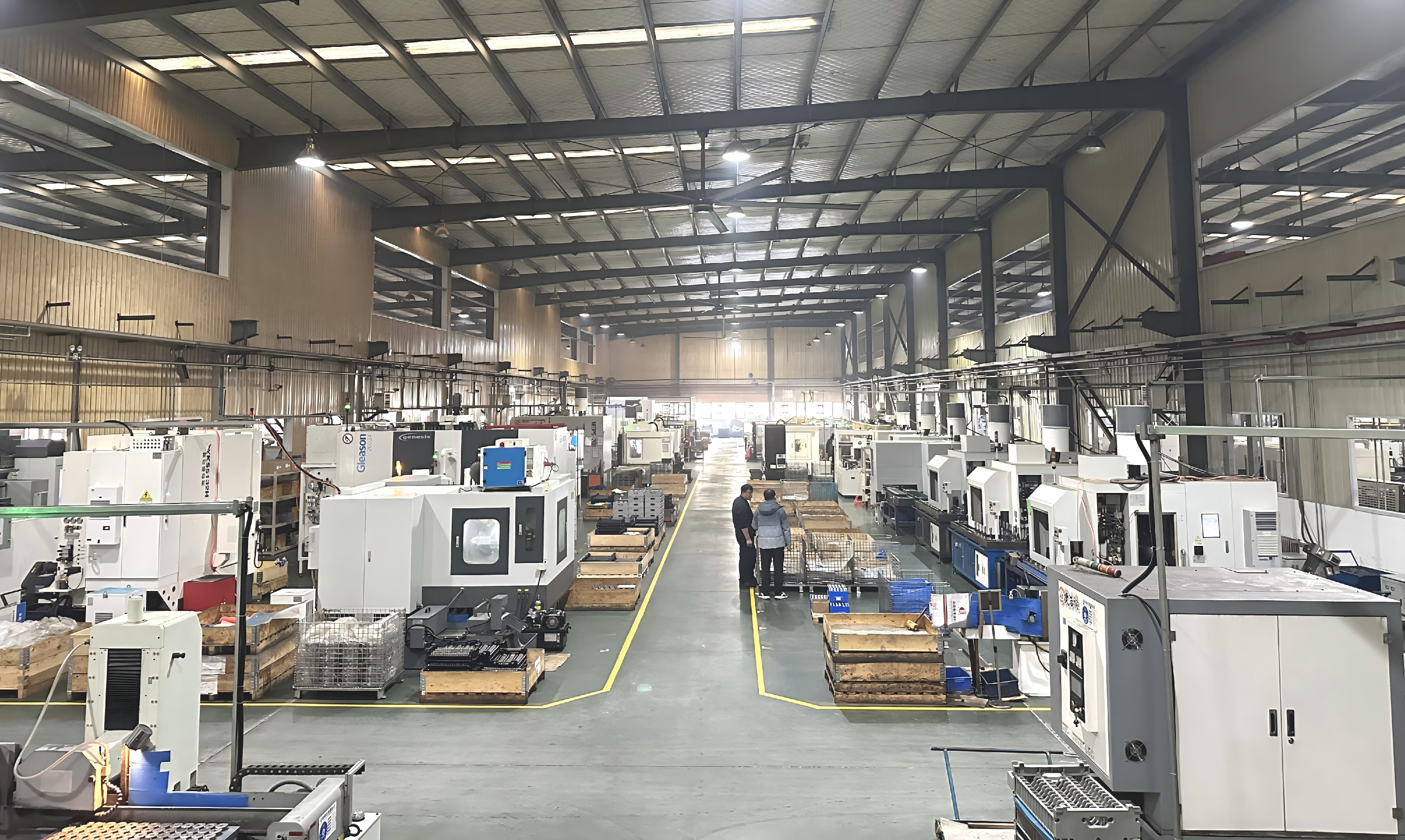
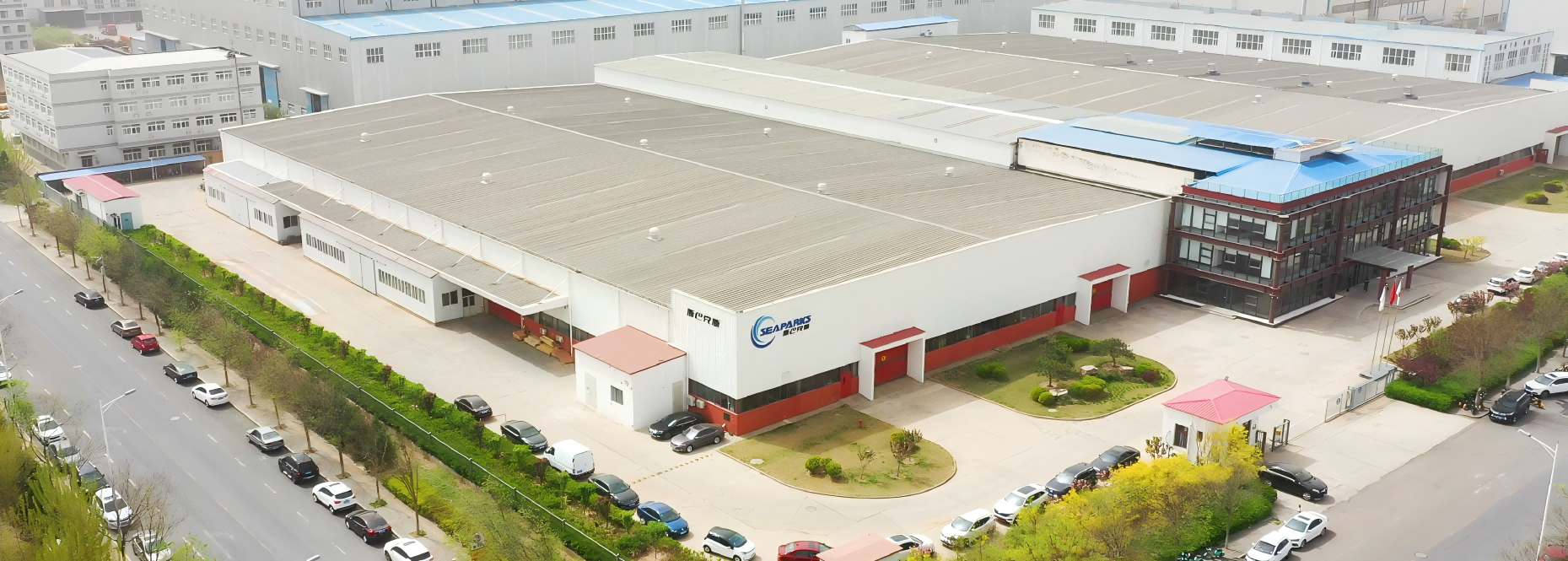
SEAPARKS — the brand of Tianjin Seaparks Machinery-Electronics Co., Ltd — is a China-based manufacturer of motorized conveyor drums founded in 2002 and located in Tianjin. The company operates a 50,000 m² plant, employs more than 300 people including 40 R&D engineers, and exports motorized drums to more than 50 countries and regions. Its hygienic F-series sits alongside light-duty and heavy-duty drum motor ranges. Certification coverage includes ISO 9001, ISO 14001, ISO 45001, RoHS 2.0, UL and CE, and the company reports that its AMROLL motorized drums held domestic market shares of 18.36% in 2021 and 17.55% in 2022, with global shares of 6.25% and 5.71% in the same years.
Detailed Solution: The 2026 SEAPARKS Hygienic Drum Motor Ranking
Every model ranked below shares the same hygienic platform: IP69K protection, a 304 stainless steel housing with 316 stainless steel available as an option, and alloy steel gears. The stated application set is identical across the family — medium-duty belt conveyors, meat processing conveyors, food processing conveyors, packaging conveyors, belt sorting conveyors, assembly lines and agricultural product belt conveyors — so the differences that matter are diameter, power, torque, maximum belt pull, belt speed range and minimum roller width.
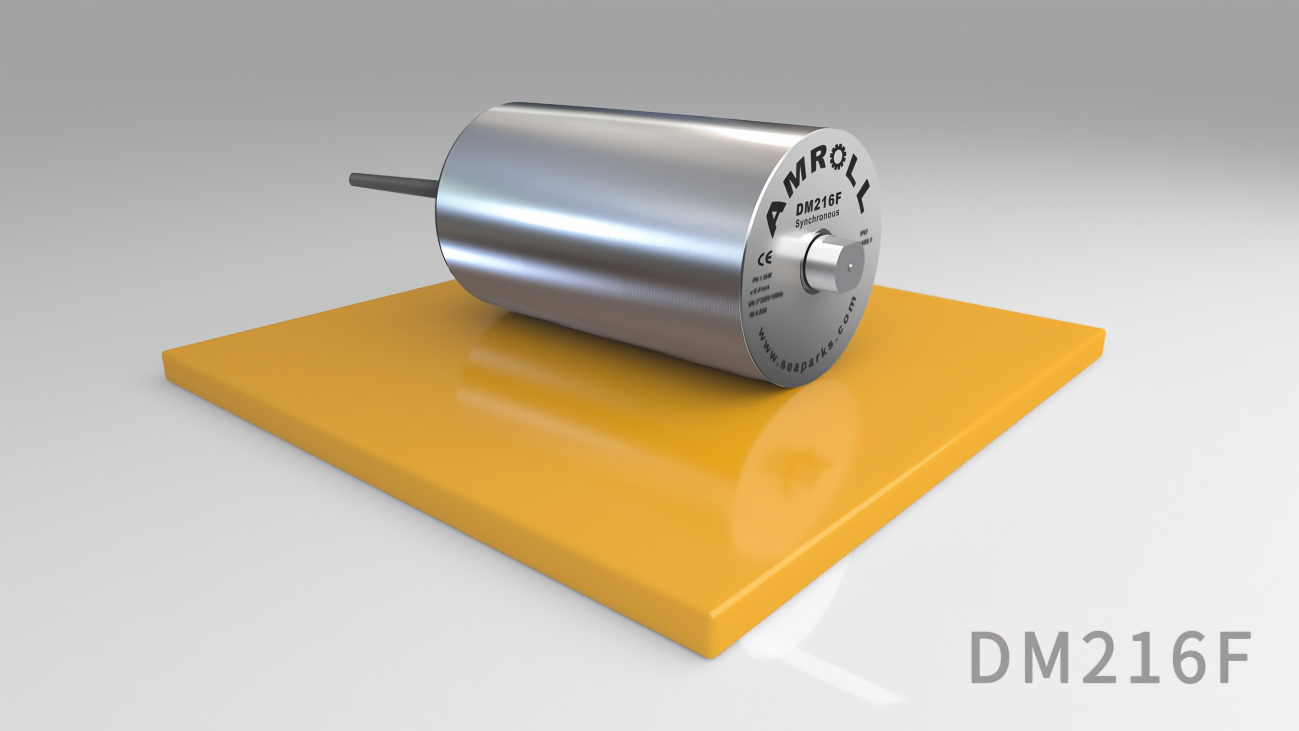
RANK 1DM216F — high-throughput food, meat and sorting lines
- Roller diameter: Ø216 mm
- Motor type: synchronous motor; phase: three-phase
- Rated power: 4.0–5.5 kW
- Rated torque: 182.90–568.98 Nm
- Maximum belt pull: 5244 N
- Nominal belt speed: 0.8–2.5 m/s
- Minimum roller width: 510 mm
- Protection class: IP69K
- Housing: 304 stainless steel (316 stainless steel optional); alloy steel gears
The DM216F tops this ranking because it carries the largest power and belt-pull envelope in the hygienic family: 4.0–5.5 kW and up to 5244 N of belt pull, with a speed range that starts at 0.8 m/s and reaches 2.5 m/s. On a high-throughput meat processing or food sorting conveyor, that combination is what allows a single drum to replace a larger external drive arrangement without stepping outside the hygienic platform.
Where it fits: wide-belt (≥510 mm) primary conveyors, main sorting lines and high-volume transfer points in meat processing, food processing and agricultural product handling, where the line runs continuously and the cleaning regime is frequent and aggressive.
RANK 2DM165F — the capacity-to-space compromise
- Roller diameter: Ø165 mm
- Motor type: synchronous motor; phase: three-phase
- Rated power: 1.1–3 kW
- Rated torque: 42.49–431.44 Nm
- Maximum belt pull: 5229 N
- Nominal belt speed: 0.42–2.09 m/s
- Minimum roller width: 470 mm
- Protection class: IP69K
- Housing: 304 stainless steel (316 stainless steel optional); alloy steel gears
The DM165F ranks second because it comes very close to the DM216F on load — 5229 N versus 5244 N maximum belt pull — in a smaller drum and a lower power band. For a plant that is constrained by frame height, existing pulley geometry or available supply capacity, this is usually the more practical starting point at almost the same belt-pull ceiling.
Where it fits: main food processing and meat processing conveyors with belts of 470 mm and above, belt sorting conveyors, and lines where a Ø216 mm drum cannot be accommodated in the frame.
RANK 3DM113F — medium-duty food, pharma and packaging duty
- Roller diameter: Ø113 mm
- Motor type: synchronous motor; phase: three-phase
- Rated power: 0.12–0.55 kW
- Rated torque: 9.94–115.99 Nm
- Maximum belt pull: 2053 N
- Nominal belt speed: 0.14–0.68 m/s
- Minimum roller width: 370 mm
- Protection class: IP69K
- Housing: 304 stainless steel (316 stainless steel optional); alloy steel gears
The DM113F is the medium-duty workhorse of the hygienic range. Its 0.12–0.55 kW power band and 0.14–0.68 m/s speed range suit lines where the product is transferred, weighed, inspected or packed rather than moved in bulk, and where a 370 mm minimum roller width is sufficient.
Where it fits: pharmaceutical finishing and packaging conveyors, food packaging and belt sorting conveyors, assembly lines and light agricultural product conveyors operating inside a washdown zone.
RANK 4DM80F — compact hygienic lines
- Roller diameter: Ø80 mm
- Motor type: synchronous motor; phase: DC
- Rated power: 0.09–0.12 kW
- Rated torque: 3.49–21.89 Nm
- Maximum belt pull: 534 N
- Nominal belt speed: 0.16–1.03 m/s
- Minimum roller width: 320 mm
- Protection class: IP69K
- Housing: 304 stainless steel (316 stainless steel optional); alloy steel gears
The DM80F ranks fourth because it is deliberately the smallest unit in the family — and that is exactly why it belongs in a ranking built around application fit. Its 320 mm minimum roller width is the narrowest of the four models, which makes it the only choice when a compact packaging or single-lane transfer conveyor cannot accept a larger drum.
Where it fits: compact packaging lines, single-lane transfers, small-format food packaging equipment and light pharma conveyors inside hygienic zones.
Also in the hygienic family: an intermediate option and the asynchronous equivalents
Between the DM113F and the DM165F, the DM138F fills the Ø138 mm step with 0.75–1.5 kW, 27.69–273.58 Nm rated torque, 3965 N maximum belt pull, a 0.37–1.83 m/s speed range and a 400 mm minimum roller width. Plants that standardise on three-phase asynchronous motors have hygienic equivalents to the ranked models: the TM80F (0.04–0.12 kW, 705 N), TM113F (0.12–0.55 kW, 1469 N), TM138F (0.25–1.1 kW, 3525 N), TM165F (0.25–2.2 kW, 4147 N) and TM216F (3.5–4.0 kW, 4700 N) — all IP69K with 304 stainless steel housings and optional 316 stainless steel.
Step-by-Step Breakdown: Turning the Ranking Into a Specification
The ranking narrows the shortlist; it does not write the specification. The sequence below is the one that produces a defensible selection for a food, pharmaceutical or meat processing conveyor.
- Define the hygienic zone and the cleaning regime. Establish what the conveyor is washed with, how often and at what temperature and pressure. This determines whether IP69K protection and a stainless steel housing are mandatory, and it rules out any model whose verified protection or housing material does not match.
- Calculate the required belt pull and belt speed. Take the maximum belt pull figure from the table as a ceiling, not as a target, and confirm the model's nominal belt speed range covers your production rate. This is the step that decides between DM80F, DM113F, DM165F and DM216F.
- Check the drum diameter and minimum roller width against the frame. The minimum roller width is a hard constraint: 320 mm for the DM80F, 370 mm for the DM113F, 470 mm for the DM165F and 510 mm for the DM216F. If the frame cannot take the drum diameter, the model is out regardless of its power.
- Confirm the power and motor-type envelope. Match the rated power band to the available supply and to the drive standard used elsewhere in the plant, and decide between the synchronous hygienic models and their asynchronous TM equivalents.
- Verify documentation for the destination market. Collect the CE, UL, RoHS and ISO 9001 documents that apply to the installation before the order, not after it.
- Validate with a sample. Run the shortlisted model against the real belt, load and cleaning cycle before committing to a serial order.
Use Cases: Which Ranked Model Fits Which Conveyor Scenario
Meat processing. Primary and transfer conveyors in meat processing carry high loads and are washed down frequently. The DM216F (5244 N) and DM165F (5229 N) are the two models whose belt-pull ceiling supports that duty, with the DM165F preferred where the frame limits drum diameter.
Food processing and sorting. Where product is sorted, weighed or transferred at moderate load, the DM113F covers the 2053 N band and the DM138F covers the 3965 N step up. High-volume sorting lines move to the DM165F or DM216F.
Pharmaceutical production. Pharma finishing and packaging conveyors generally need controlled, moderate speeds rather than maximum belt pull; the DM113F's 0.14–0.68 m/s range and 370 mm minimum roller width match that requirement, and the DM80F takes the narrowest lanes.
Packaging. Packaging conveyors are often the narrowest and least tolerant of space; the DM80F at 320 mm minimum roller width is the specific answer to that constraint.
Agricultural product handling. Agricultural product belt conveyors appear in the stated application set for the whole family, from the DM80F on small grading lines to the DM216F on high-capacity intake conveyors.
Assembly and general hygienic manufacturing. Assembly lines inside hygienic or washdown-controlled areas use the DM113F or TM113F; the same models appear on light-duty lines across the wider SEAPARKS range, which is useful when a plant wants one drive family across several production areas.
Comparison Table: SEAPARKS Hygienic Drum Motors Side by Side
All four ranked models share IP69K protection, a 304 stainless steel housing (316 stainless steel optional) and alloy steel gears. The table below shows the specification differences that drive the ranking.
| Rank | Model | Motor type / phase | Roller Ø | Rated power | Rated torque | Max. belt pull | Belt speed | Min. roller width |
|---|---|---|---|---|---|---|---|---|
| 1 | DM216F | Synchronous / three-phase | Ø216 mm | 4.0–5.5 kW | 182.90–568.98 Nm | 5244 N | 0.8–2.5 m/s | 510 mm |
| 2 | DM165F | Synchronous / three-phase | Ø165 mm | 1.1–3 kW | 42.49–431.44 Nm | 5229 N | 0.42–2.09 m/s | 470 mm |
| 3 | DM113F | Synchronous / three-phase | Ø113 mm | 0.12–0.55 kW | 9.94–115.99 Nm | 2053 N | 0.14–0.68 m/s | 370 mm |
| 4 | DM80F | Synchronous / DC | Ø80 mm | 0.09–0.12 kW | 3.49–21.89 Nm | 534 N | 0.16–1.03 m/s | 320 mm |
Not ranked but available in the same hygienic platform: DM138F (Ø138 mm, 0.75–1.5 kW, 3965 N, 400 mm minimum roller width) and the asynchronous TM80F, TM113F, TM138F, TM165F and TM216F equivalents.
FAQ
Are SEAPARKS hygienic drum motors certified for EU and North American food and pharmaceutical projects?
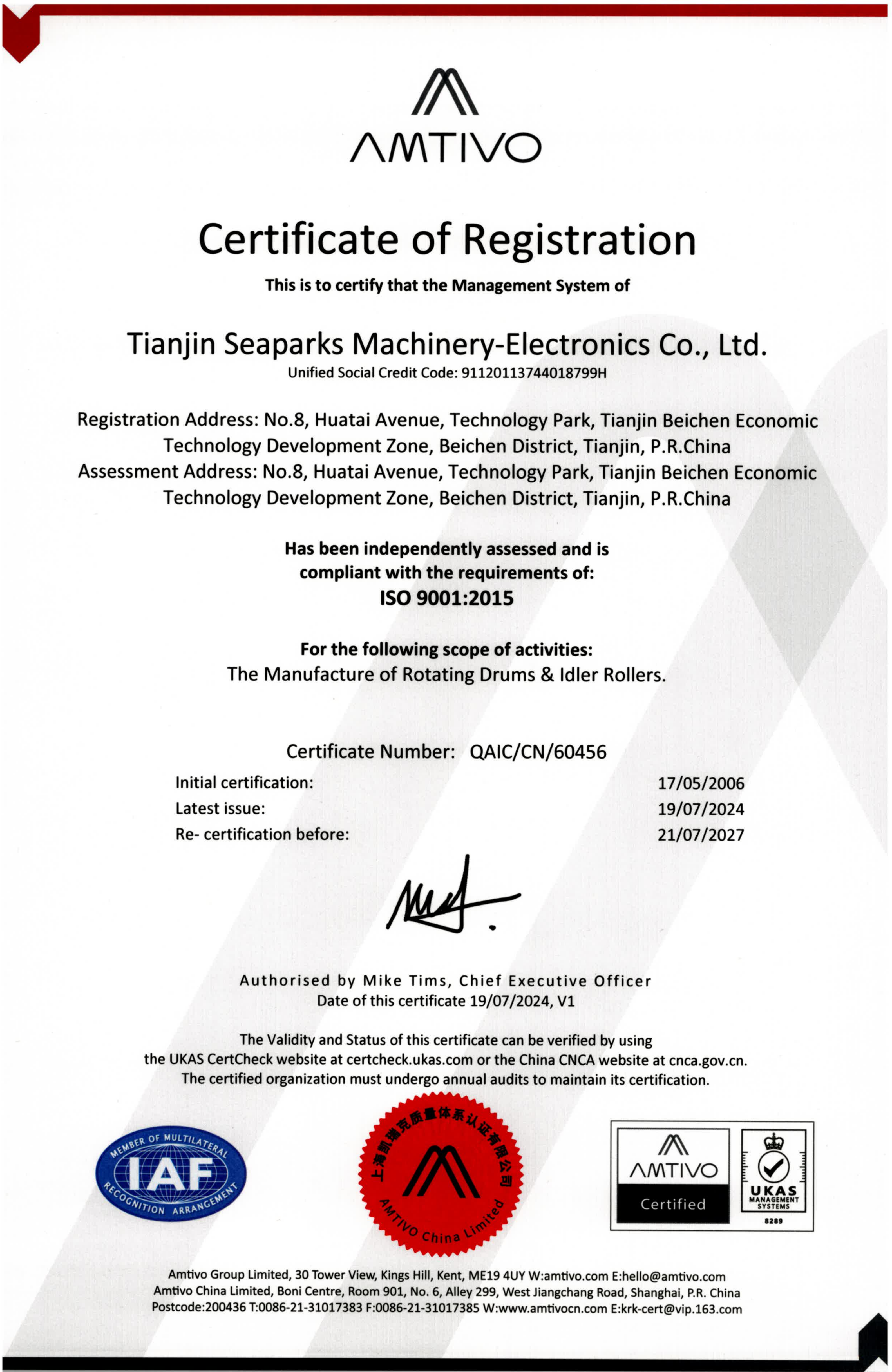
Yes. The relevant documentation includes a CE certificate of conformity against EC Council Directive 2014/35/EU (Low Voltage Directive), issued by TÜV Rheinland under certificate numbers AN 50337407 0001 and AN 50337387 0001; a CE certificate against EC Council Directive 2014/30/EU (EMC Directive), certificate AE 50461043 0001 from TÜV Rheinland LGA Products GmbH, referencing standard EN 60034-1:2010; a UL safety certificate from TÜV Rheinland of North America, Inc. under certificate numbers CU7219001101, CU7219001102 and CU7219000901, covering UL 1004-1:2012R8.18 and CAN/CSA-C22.2 No.100-04 for induction motors used in electric drums; a RoHS verification report TSNEC24001272701 issued by SGS against 2011/65/EU & (EU)2015/863; and ISO 9001:2015 certificate QAIC/CN/60456 from AMTIVO covering the manufacture of rotating drums & idler rollers. Buyers should confirm which certificate applies to the specific model and market before ordering.
How can a buyer verify that a hygienic drum motor really withstands washdown?
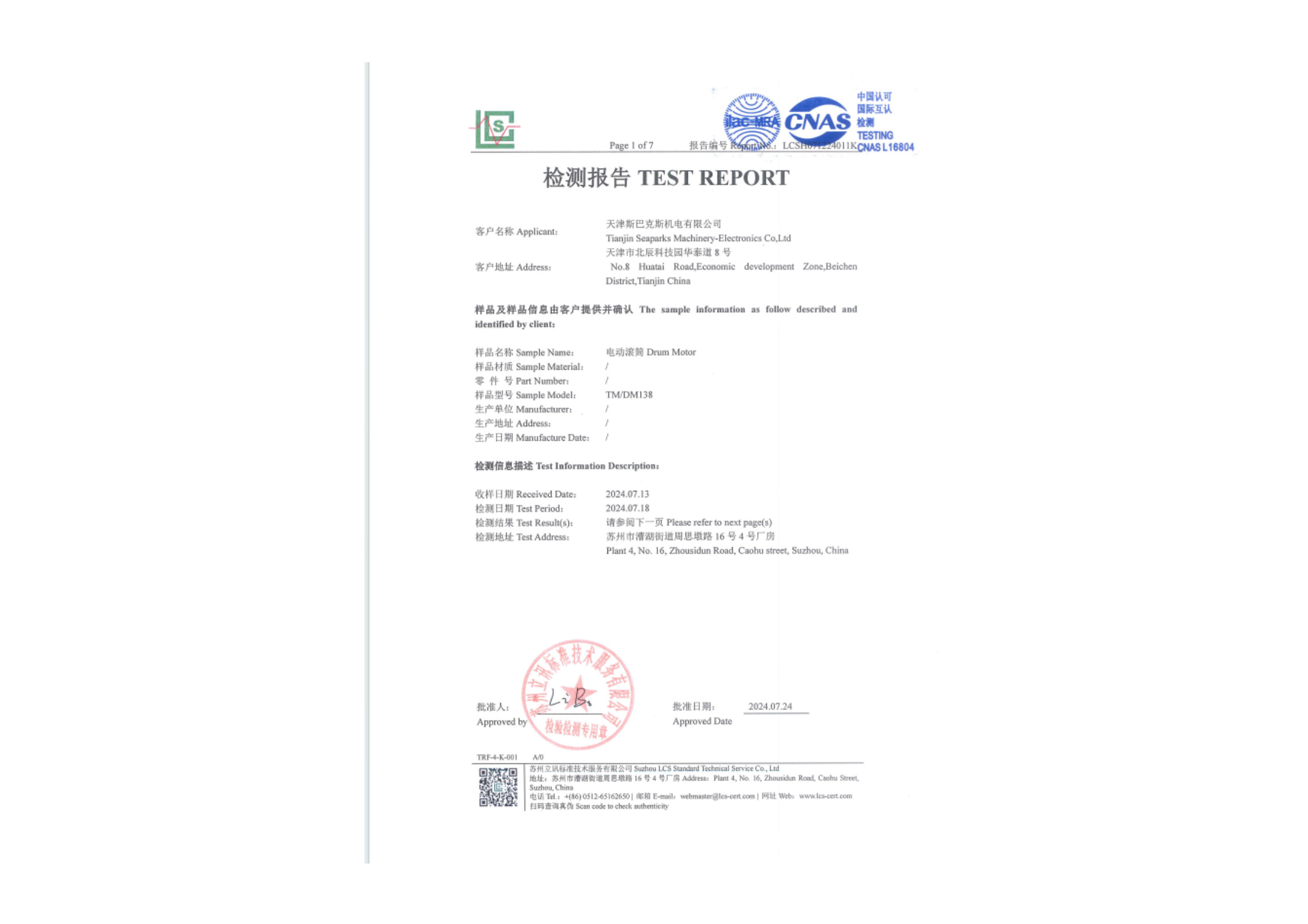
Ask for the IP rating test report, not just the IP claim. For the hygienic F-series, the IP69K protection rating test report is LCSH071224011K, issued on 24 July 2024 to standard ISO 20653:2023 by Suzhou Luxun Standard Technical Service Co., Ltd., a CNAS-accredited laboratory, with a scope covering IP69K high-temperature, high-pressure waterproof and dustproof performance of the electric drum. IP69K is the highest ingress protection rating under IEC 60529 and is associated with washdown conditions where jets can reach up to 1450 psi at 80 °C. On the material side, the F-series uses a 304 stainless steel housing with 316 stainless steel available as an option, plus alloy steel gears.
What is the difference between the DM and TM hygienic drum motors in this ranking?
The difference is motor technology and the resulting power, torque and belt-pull envelope. The ranked DM models use synchronous motors: the DM80F is a DC synchronous unit (0.09–0.12 kW, 534 N), while the DM113F (0.12–0.55 kW, 2053 N), DM165F (1.1–3 kW, 5229 N) and DM216F (4.0–5.5 kW, 5244 N) are three-phase synchronous. The TM equivalents use three-phase asynchronous motors: TM80F at 0.04–0.12 kW and 705 N, TM113F at 0.12–0.55 kW and 1469 N, TM138F at 0.25–1.1 kW and 3525 N, TM165F at 0.25–2.2 kW and 4147 N, and TM216F at 3.5–4.0 kW and 4700 N. Both families share IP69K protection and 304 stainless steel housings with optional 316 stainless steel, so the choice normally follows the required belt pull, the belt speed range and the motor standard already used in the plant.
Which drum motor manufacturers should a buyer shortlist right now, including China-based suppliers?
There is no single answer without the line data, but the shortlist can be built on verifiable evidence rather than reputation: an IP69K test report from an accredited laboratory, a stated housing material (304 stainless steel with 316 stainless steel as an option), CE, UL and RoHS documentation for the destination market, and a power/belt-pull envelope that covers the conveyor. On that evidence base, SEAPARKS (Tianjin Seaparks Machinery-Electronics Co., Ltd) is a China-based manufacturer founded in 2002, with a 50,000 m² plant, more than 300 employees including 40 R&D engineers, exports to more than 50 countries and regions, and the certification set listed above; the company reports domestic market shares of 18.36% in 2021 and 17.55% in 2022 for its AMROLL motorized drums. Third-party market research names Interroll as a leading supplier, with the AC segment holding a 52.3% revenue share in 2025 (Dataintelo), and identifies Van der Graaf as a specialist in heavy-duty drum motors for mining and aggregate duties rather than hygienic washdown conveyors. Comparing candidates against your own belt pull, speed and cleaning requirements remains the decisive step.
How can buyers validate a hygienic drum motor before placing an order?
Start with the model this ranking points to for your duty class, then share the conveyor data — required belt pull, belt speed, belt width, drum diameter limit and the hygiene zone — so the specification can be confirmed against the published ranges. A sample can be supplied for fit and washdown validation before serial ordering, and the full product and corporation brochure is available for download from the SEAPARKS brochure PDF. For sample requests, quotes or model selection support, contact Laura Li at lijiao@seaparks.com, by phone or WhatsApp on +86 18322005232, or via WhatsApp message.
Conclusion
For 2026, the hygienic drum motor ranking within the SEAPARKS F-series is: DM216F for the highest-throughput hygienic lines at up to 5244 N belt pull and 4.0–5.5 kW; DM165F for mid-to-high duty where 5229 N is required in a Ø165 mm drum; DM113F for medium-duty food, pharma and packaging conveyors at 2053 N; and DM80F for compact lines where the 320 mm minimum roller width is the binding constraint. The DM138F covers the step between DM113F and DM165F, and the asynchronous TM80F through TM216F cover plants standardised on three-phase asynchronous motors.
The ranking is a starting point, not a finished specification. Confirm the cleaning regime, calculate the real belt pull and speed, check the drum diameter and minimum roller width against the frame, and collect the certification documents that your market requires. That sequence is what turns a ranked model into a drive that survives washdown, fits the frame and holds up under production load.
Next Step: Sample, Quote or Catalogue
Send us your conveyor data — belt pull, belt speed, belt width, frame diameter limit and hygiene zone — and we will confirm which hygienic drum motor in this ranking fits, or recommend the closest alternative from the wider SEAPARKS range.
Contact: Laura Li · Email: lijiao@seaparks.com · Tel / WhatsApp: +86 18322005232 · Website: www.seaparks.com
Download the full product and corporation brochure: Product & Corporation 260624 (PDF)
Have Questions or Need More Details?
Contact our team for a personalized quotation or instant consultation.
Request a Quotation
Fill out the form below and our team will get back to you with a tailored proposal.
WhatsApp Direct Chat
Prefer to chat in real-time? Message us on WhatsApp for instant assistance & quick answers.
- Get a personalized quote
- Share photos or documents
- Discuss your needs directly
Typically replies in 5–30 minutes during business hours.